
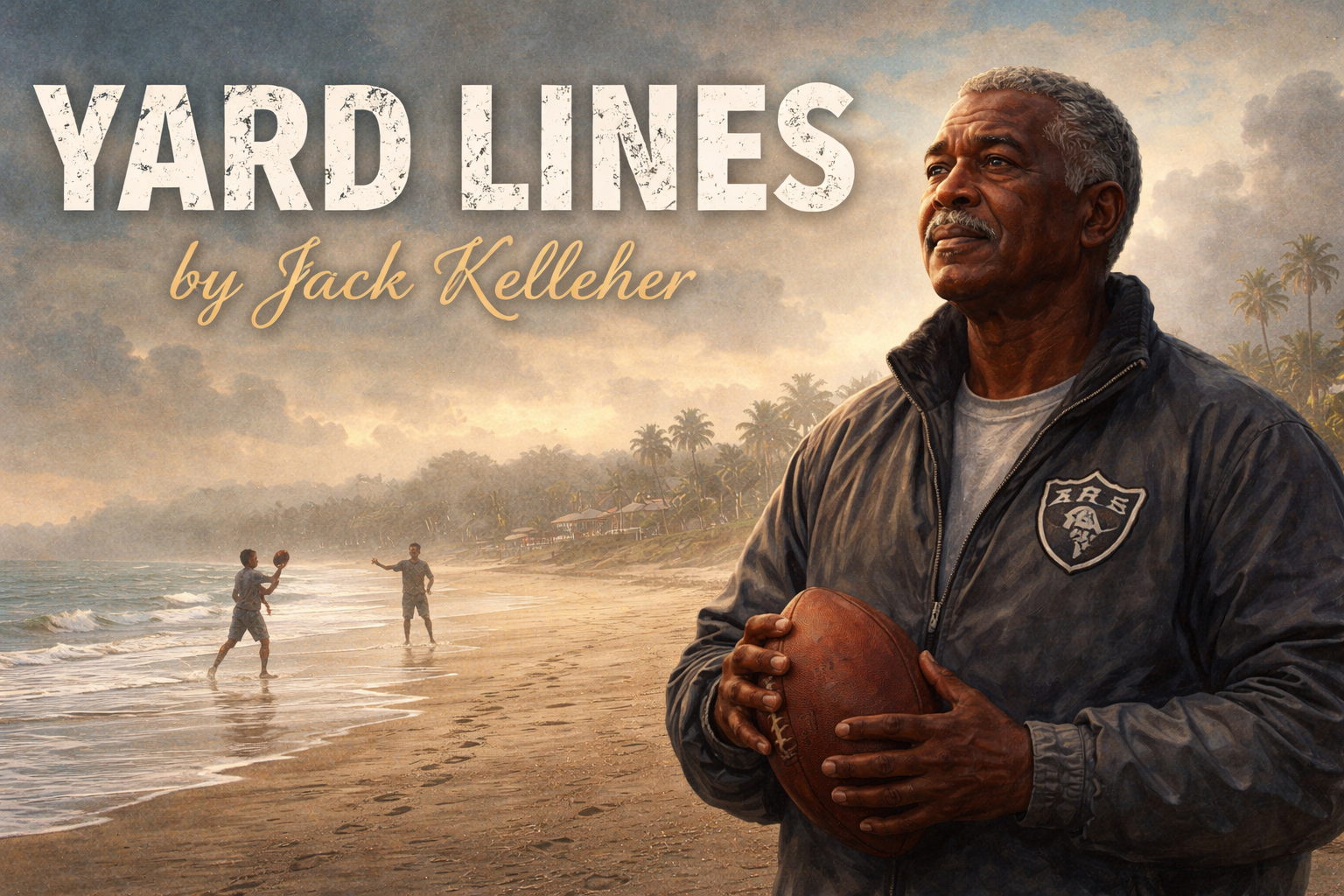
When Congressman Charlie Pink opened his eyes, he saw his left hand, palm up, an IV line snaking into his forearm. Like his name, his palm was pink—a campaign joke he recycled whenever he stumped for re-election. And, like the rest of him, his hand was very large and seventy years old.
Oxygen tubing rested in his nostrils, its cool green flush penetrating deep into his sinuses with every breath. He also recognized the time-bending feel-good of an opioid blurring his senses, a high he had first met long ago during his professional football career.
“It’s been quite a while, old pal,” he mumbled.
He closed his eyes but could not return to sleep. Beneath the dreamy euphoria a throbbing pain pulsed in his pelvis. It felt oddly separate from him, yet closing fast—a tsunami with every breath.
The window beyond the bed was black as an empty chalkboard, but the room floated in hospital twilight. A privacy screen had been pulled around his bed. For a moment Charlie felt as if he were hovering above it, looking down at himself—a large black woolly bear wrapped inside a crenelated white cocoon.
Nearby, above the bleeping monitors, he heard the snorting and farting of his ward-mates. Men, he assumed, judging from the barnyard symphony leaking through the curtain.
Charlie opened his eyes again and stared at the ceiling.
The square white tiles formed a grid. Their seams ran straight and measured, like yard lines beneath his cleats on Sundays in the fall.
For a moment he had the sensation that if he listened carefully, he might hear the crack of a football slapping into his outstretched hands.
Pain surged again.
Charlie squeezed the nurse call button. Too much pain was leaking in. He wanted more painkiller—another spike of the dragon.
Time fogged, softened and drifted.
Eventually a sleepy middle-aged Hispanic man in green scrubs appeared at the foot of the bed.
“Do you need something, Mr. Pink?”
“What am I doing here?” Charlie asked.
“My name’s Nurse Contreras, Mr. Pink, but you can call me Sammy. I got a feeling we’re going to get to know each other pretty good.” Sammy grinned and ran his fingers through what remained of his hair.
“Okay, Sammy,” Charlie said. “But I can’t say it’s nice to meet you because it isn’t. I’m in a hospital, I’ve got terrible pain in my hips, and I don’t know how in hell I got here. Can you give me something?”
“Let me look at your chart.”
“Nurse—Sammy—I’m due right now. I’m a retired NFL player. Higher drug tolerance than most folks.”
Sammy squinted at him. “I remember you. Charlie Pink. Charlie Good Hands—manos buenos. Oakland Raiders. Back when Snake Stabler was quarterback. My papa and I watched those games every Sunday.”
Charlie managed a weak smile.
“I still am great. How about I trade you my autograph for a little Demerol?”
“Deal.”
Sammy laughed and returned with a syringe. “It couldn’t do you no harm, Charlie. You’re already messed up. Nobody becomes an addict at your age.”
The drug slid into the IV port. The room faded to grey.
Later that afternoon Charlie went into surgery, delayed because he had arrived at Palo Alto General as a John Doe cyclist—the victim of a hit-and-run driver. Hospital administration paused the procedure until insurance coverage could be verified. No one had yet realized the fit-looking old Black man was a Congressman with excellent health benefits.
When Charlie woke again, Sammy stood at the foot of the bed. “Hey, Charlie. How do you feel?”
“Like somebody ran me over with a truck.”
Sammy nodded. “That’s about right.”
He leaned on the bed rail. “Pickup truck hauling chickens. Witnesses say the driver swerved for you. Hit-and-run.”
Charlie blinked slowly. “A chicken farmer?”
Sammy shrugged.
“Maybe he hates politicians. Maybe he hates old men on bicycles.”
“Maybe both,” Charlie said.
“Maybe both.”
Sammy adjusted the monitor leads. “You owe anything to a chicken farmer?”
“No,” Charlie said faintly. “Just voters.”
Sammy laughed. “Your surgery went good. Doctors say you’re in great shape for an old guy.”
He paused, thoughtful. “I was a combat medic in Iraq. Two tours. battle trauma, everything. Now I empty bedpans.”
Charlie studied him. “You saved lives over there.”
Sammy shrugged. “Sometimes.”
“That’s good work,” Charlie said.
Sammy looked embarrassed and busied himself with the chart.
Later, when the ward settled into quiet, Charlie stared again at the ceiling tiles.
The seams stretched across the room like yard lines.
Ten yards. Twenty. Thirty.
Then the hospital room dissolved.
He was standing barefoot on the strand at Fremont Beach. Cold Pacific water washed around his ankles. The wind pushed fog across the water, and the sand lay hard and flat as a football field.
Frankie Duncan stood twenty yards away holding a football. “You ready, Charlie?”
“Go long, flag left!”
Frankie launched the ball high into the offshore wind. It straightened into a tight spiral.
Charlie ran under it and caught it cleanly.
“Good hands!” Frankie shouted.
They had been playing this game since they were kids. No helmets, no coaches—just the empty beach and the ocean.
Frankie trotted closer. “You’re gonna play in the NFL someday.”
“Maybe,” Charlie said.
Frankie squinted at him. “What’s eating you?”
Charlie stared out toward the fog bank offshore.
“I need tell you something.”
Frankie waited.
Charlie forced the words out. “I’m queer. I like guys. I can’t help it.”
The wind moved between them.
Frankie looked down at the football. Finally, he shrugged. “Okay.”
Charlie blinked. “Okay?”
Frankie tossed him the ball. “You still catch passes, don’t you?”
Charlie caught it automatically. “Yeah.”
“Then I don’t see the problem.”
Something loosened in Charlie’s chest. “You won’t tell anybody?”
Frankie snorted. “Who would I tell?”
He backed away down the strand. “Come on, Pink. Run the route.”
Charlie sprinted through the sand.
Frankie’s pass cut through the fog in a perfect spiral.
Charlie caught it against his chest.
Frankie grinned. “Told you,” he said. “You got good hands.”
Charlie woke again in the hospital.
The ceiling tiles returned.
Frankie Duncan had died in Vietnam five years after that day on the beach. He had kept Charlie’s secret longer than he had kept his own life.
Charlie lay quietly. He thought of Harvey Milk. Of James in Winnipeg. Of the long years of silence.
The pickup truck had tried to erase him.
Maybe the driver hated Black men.
Maybe he hated gay men.
Maybe both.
Charlie no longer cared which.
Hatred rarely needed logic.
Only courage answered it.
“Sammy,” he called.
The nurse appeared. “Que pasa, vato? Pain?”
“No.” Charlie looked down at his hands.
“When the doctors let me out of here,” he said, “how long before I can stand in front of a microphone?”
Sammy blinked. “A microphone?”
“I’m a politician,” Charlie said. “It’s what we do.”
“What you planning to say?”
Sammy waited.
For a moment Charlie was back on Fremont Beach, a skinny kid standing in the wind with a football in his hands and Frankie Duncan watching him without judgment.
He realized, not for the first time, how much courage could grow from the simple decency of another man.
Charlie watched the oxygen tube rise and fall.
“The truth.”
Sammy nodded slowly.
Charlie smiled faintly.
“I’ve been playing defense too long.”
Outside the window the sky had begun to brighten.
Charlie imagined Father Mike nearby raising an eyebrow, Flora beside him with her arms folded.
“Well,” Sammy said slowly, “sounds like a speech.”
Charlie nodded. “Yeah.”
He looked once more at the long white yard lines stretching across the ceiling.
“I think it’s time I ran a different route.”
For the first time since the truck struck him, the field ahead looked clear.
“Not the next play,” Charlie said quietly.
“The next half.”
Four weeks later Charlie stood behind a wooden podium in the parking lot of Cadillac Sam’s Taco Stand in Fremont Beach.
Microphones rose toward him like a small black forest.
Reporters waited.
Sammy Contraras stood to one side, watching.
Charlie rested his big hands on the podium.
“For most of my younger life I played football. Later politics. In both games you learn something early: if you want to win, you’ve got be true, true to yourself and to your fans. Nothing short of that will do.”
A few reporters looked up.
“I was hit by a truck last month. Maybe it was because I’m a Black man. Maybe because I’m a gay man. Maybe both.”
He paused.
“But hatred thrives on silence.”
The plaza grew quiet.
“So today,” Charlie said, “I’m done with the shadows.”
He took a breath.
“My name is Charlie Pink. I’m your congressman. And I’m a gay man.”
Questions erupted.
Charlie stepped back from the podium and looked out across the small crowd.
For an instant he saw another shoreline—the fog rolling across Fremont Beach, the sound of waves, a skinny kid standing in the wind with a football under his arm.
Frankie Duncan grinning.
‘’Run the route, Pink. I’ll get the ball to you.’’
Charlie smiled to himself.
And after all these years, the ball was finally sailing to his hands again.