
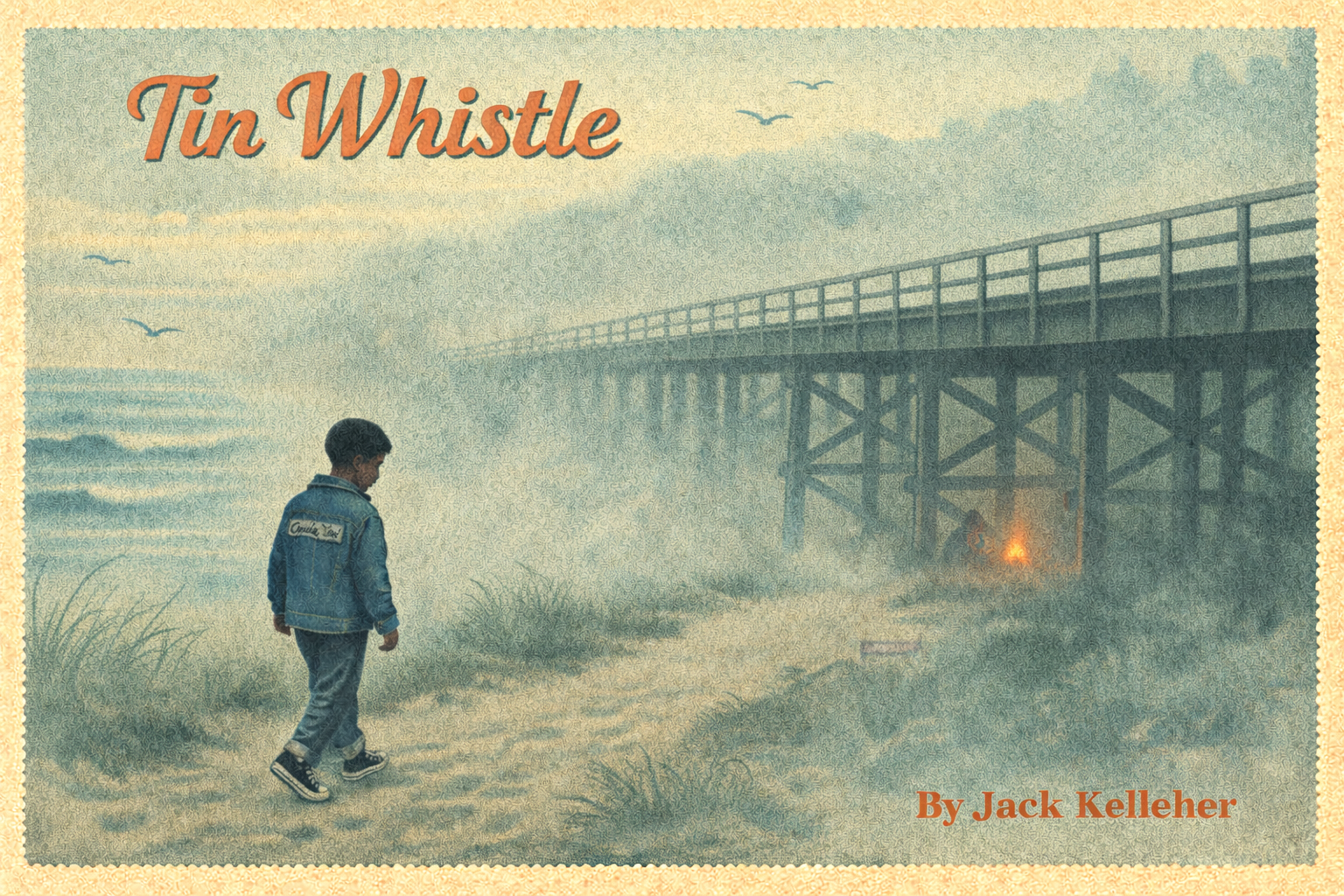
Charlie Pink trembled with fear. Dense fog tugged at his sleeves, eddying around his ankles as he walked the railroad tracks. Looking down, he could just see his feet. ‘I ain’t scared,’ he whispered, but he was lying. He could hear the muffled rumble of the surf across the Camino Real. He couldn’t see the ocean, but he knew where he was by its sound. Near the trestle bridge, the beach was rocky and made a different murmur. It sounded like people talking in another room. It smelled different too, of kelp and dead things. After he crossed the bridge, it would be only seven blocks uphill to Freemont Elementary School.
Charlie liked to go early and sit in the cafeteria. It was warm there and sometimes Gladys, the cafeteria lady, would sneak him a slice of buttered toast. She wore a hairnet and lime green uniform with a funny little hat pinned on top. She smelled like milk and cinnamon. Gladys was his only friend.
Charlie walked to school early because the big kids were still inside their houses and wouldn’t chase him throwing stones and calling him nigger. After school it was easy to outrun them because he was super-fast and running downhill.
Charlie’s black high top tennis shoes had holes on the outside by his little toes, but his socks and tee shirt were sparkling clean. His Granny had stitched his name over the pocket of his blue-jean jacket. It used to say ‘Charles Pink,’ but the ‘P’ had unravelled so now his name was ‘ink.’ That’s what the kids called him too, Charlie Ink, ‘Inky.’
He walked slowly, just scuffing one foot in front of the other so he wouldn’t trip in the fog and get his clothes dirty. His Granny didn’t like dirty clothes, no sir, or what she called ‘makin’ exrey work.’ ‘Charles Ransom Pink,’ Granny would say, ‘there’s enough hard work in this life without you makin’ extrey.’ Then she’d tell him to pick up his room or clean his army men off the floor.
After supper, Charlie always stood on a kitchen chair turned backwards and did the dishes while Granny listened to The Lawrence Welk Show on the radio. Then Charlie would take a bath, brush his teeth, say his prayers, and get to bed. He’d pretend to sleep.
Lying in bed, he could hear Granny’s radio. She listened to ‘Gang Busters,’ ‘Inner Sanctum,’ and ‘The Shadow.’ Right now, Charlie was thinking about ‘The Shadow.’ It started with real creepy music and then a deep, scary voice said ‘Who knows what evil lurks in the shadows?’ The fog was all shadows and he could see faces in its swirl. Watching him. So, he looked at his feet and told himself again that he wasn’t scared. He was brave soldier like his daddy, before he went to be with God.
Then Charlie heard music coming from under the trestle bridge. It wasn’t a harmonica, like he played. It sounded like a train whistle, puffy, but low, and soft like it was made out of fog. He recognized the tune, ‘Oh Susanna,’ one of the songs he’d learned to play by heart. He listened to the music rising gently out of the space between the trestle sleepers. It sounded sad, like sighing, against the murmur of the sea.
Charlie sat on a bridge abutment and let his legs dangle into the fog. He knew he should keep going. He should run! Whoever was making the music was a stranger and he wasn’t supposed to talk to strangers. Granny said so. But the music was so sweet; it made him feel warm and not scared. Although he still couldn’t see who was making the music, he could see a red glow in the gully beneath him. There was a small fire, no more than a couple of sticks of driftwood. Charlie wished he could warm himself a little. He was awful cold.
The tune stopped, Charlie waited. He wanted to hear another tune, but all he could hear was the surf and a noise like a tin can scraping on a rock. He wasn’t really thinking. His Granny said he didn’t think, he just drifted and dreamed. And now, just drifting and dreaming, he took his harmonica from his jacket pocket, unrolling it from the soft cloth in which he kept it. Charlie played ‘You Are My Sunshine,’ slow and pretty, just like the stranger had played ‘Oh Susanna.’ Then, out of the fog the stranger played ‘You Are My Sunshine’ right back in the same key as Charlie’s harmonica. And then they played it together, still apart in the fog. It sounded like an echo, but nicer.
‘Hello,’ said an old voice. ‘Would you like to come closer to my fire?’ Charlie didn’t say anything. ‘Willie McBride’s my name. I’m a traveller. Folks call me a tramp, but I’m no bum and I never harmed a living soul.’ Charlie didn’t say anything, but he played ‘Red River Valley’ and, below in the fog, Willie played along.
When he stopped playing he looked down again. Then there was a face in the fog, but it wasn’t scary, just old. Willie wasn’t much bigger than Charlie and bent over a little. He had sea green eyes and a twisty walking stick. He had a wool cap which flopped over its brim, and a harp pin in his lapel. He wore a tattered coat, baggy pants, a vest, and, to Charlie’s surprise, a necktie, just like Mr Hahn, the school Principal, wore. Looking up at him out of the fog, Willie offered a wide smile, crinkling the corners of his eyes. Still drifting and dreaming, Charlie jumped down to the creek bed.
‘Do you have a name, lad, or are you just something come out of the mist to play harmonica?’ Willie tipped his head and took a sip from a cup which Charlie could see was made from a tin can. ‘Would you like a cup of hot cocoa? I think I’ve got a bit here somewhere.’ Willie dug into an old musette bag and, like magic, produced a tin of Ovaltine. Charlie smiled and nodded yes.
‘My name’s Charlie Pink. People call me Inky. I’m on my way to school. I’m eight years old.’
‘Are you now? Well, Charlie Pink, I’m pleased to make the acquaintance of another lover of music. I’m a few years older than you, more’s the pity, and, like I told you, my name’s Willie. I’m just on my way to nowhere – passing by as the Lord Jesus tells us all to do. ‘Be passers-by,’ saith the Lord in the Gospel of Thomas. I used to be a soldier, but it made me crazy so one day I just ran away, passed by you might say. I’ve been travellin’ ever since. Would you like to play ‘Red River Valley’ while the water’s trying to make itself warm enough to be Ovaltine?’
‘What do you call the thing you’re playing, Mr McBride?’
‘Just Willie, Inky, and this lovely instrument is a tin whistle, God’s gift to the poor man. I learned to play it when I was a boy and can’t seem to stop. A tin whistle is a great comfort to a traveling fellow, almost as much as my Ruby here. She’s a traveller too.’
For the first time, Charlie noticed a small, brindle Collie dozing against Willie’s pack.
‘Ruby’s not too frisky any more, but then neither am I. Praise Jesus, my joints are still strong.’ Saying this, Willie poured boiling water from a large tin can into a smaller one which had been fashioned into a cup with a coat hanger handle.
Charlie’s Ovaltine cooled quickly, but as he drank it he stopped shivering even though the mist seemed to be thicker than before. Charlie was warm and didn’t feel scared at all. Willie rolled a cigarette which he then lit from the end of a twig in his small fire.
‘Do you like to play music, Inky?’ Willie asked.
‘It’s all I like at school,’ Charlie replied. ‘I collected soda pop bottles to buy my harmonica so I could join Miss Levi’s Harmonica Band. Miss Levi gets them for us, but they cost a whole dollar. I found the bottles on the beach. People just throw them away, but they’re worth a nickel apiece. I always collect bottles, but usually I give the money to my Granny.’
‘Inky,’ said Willie, ‘it’s a fine thing collecting the bottles. You tidy up the Lord’s lovely ocean and you help pay your own way. I pick up bottles too and I peddle handmade thimbles and sewing needles to the ladies, door-to-door. I whittle the thimbles from driftwood and bone. Sometimes when I’m in a city, I play my tin whistle in the street if the coppers don’t run me off. Music is sweets to the angels, Inky, so if you want your guardian angel near you, keep playing your music. The angels gather when they hear a tune.’
Charlie finished his Ovaltine. He and Willie played ‘You Are My Sunshine’ one last time. Then, Charlie stood up, carefully brushing the seat of his school trousers so Granny wouldn’t have extry work to do. ‘I’ve got to go to school, Willie,’ he said, feeling sad to leave his new friend, but knowing his Granny would give him a licking for sure if he was late.
Willie stood up, made a little bow right from the waist, and shook Charlie’s hand, just like he was a grown-up. Willie looked to Ruby and said, ‘Remember your manners, darling.’ And with that, Ruby stood up and offered Charlie her paw.
As Charlie clambered up the embankment, Willie called after him, ‘It’s been a fine thing chattin’ with you, Charlie Pink. God bless all living creatures. Remember to play your music and say your prayers.’
Charlie ran all the way up Freemont Street and sat down just as the second bell rang. Teacher scowled at him, but didn’t send him to the office.
* * *
After school, Charlie flew down Freemont Street, but this time he ran a little faster, arriving at the trestle bridge breathless and with a stitch in his side. Sun glistened off the sea and the waves were high, pounding like they wanted to tear the land away. Squadrons of gulls stood in formation among the mounds of kelp. A storm was coming. The wind smelled like lightening.
Charlie scrambled down to the creek, but Willie and Ruby were gone. He couldn’t even find where Willie’s fire had burned or any sign that someone had slept there. He wondered if he’d imagined Willie. Had he been drifting and dreaming again? Charlie stood still and listened to the ocean, the wind, and sea birds’ cries. Sunshine warmed his chest and the concrete abutment radiated the warmth it had collected throughout the day. He sat with his back against the warm cement and played his harmonica, alone in the wind by the little creek where it met the sea. He wondered if his guardian angel was listening.
As he rose and brushed his trousers, Charlie noticed something on the abutment where he’d jumped down that morning. Worried that he might have torn his jacket, he picked his way through the stones. There, in a blue and red box lettered ‘Clarke’s Tin Whistle – 1843’ was a brand new whistle, just like Willie’s. A note was stuffed into the top of the box. It read, ‘For Inky from your pal Willie, November, 1951.’
Charlie stood on the trestle facing the surf, his arms outstretched, drifting and dreaming he was a Seagull flying over the ocean. He clutched the tin whistle in his left hand. In the distance, he heard the call of an approaching freight train. Just then, the offshore wind gusted and, to his wonder, the tin whistle moaned in reply. It was the most beautiful sound in the world. Charlie knew his guardian angel was nearby.