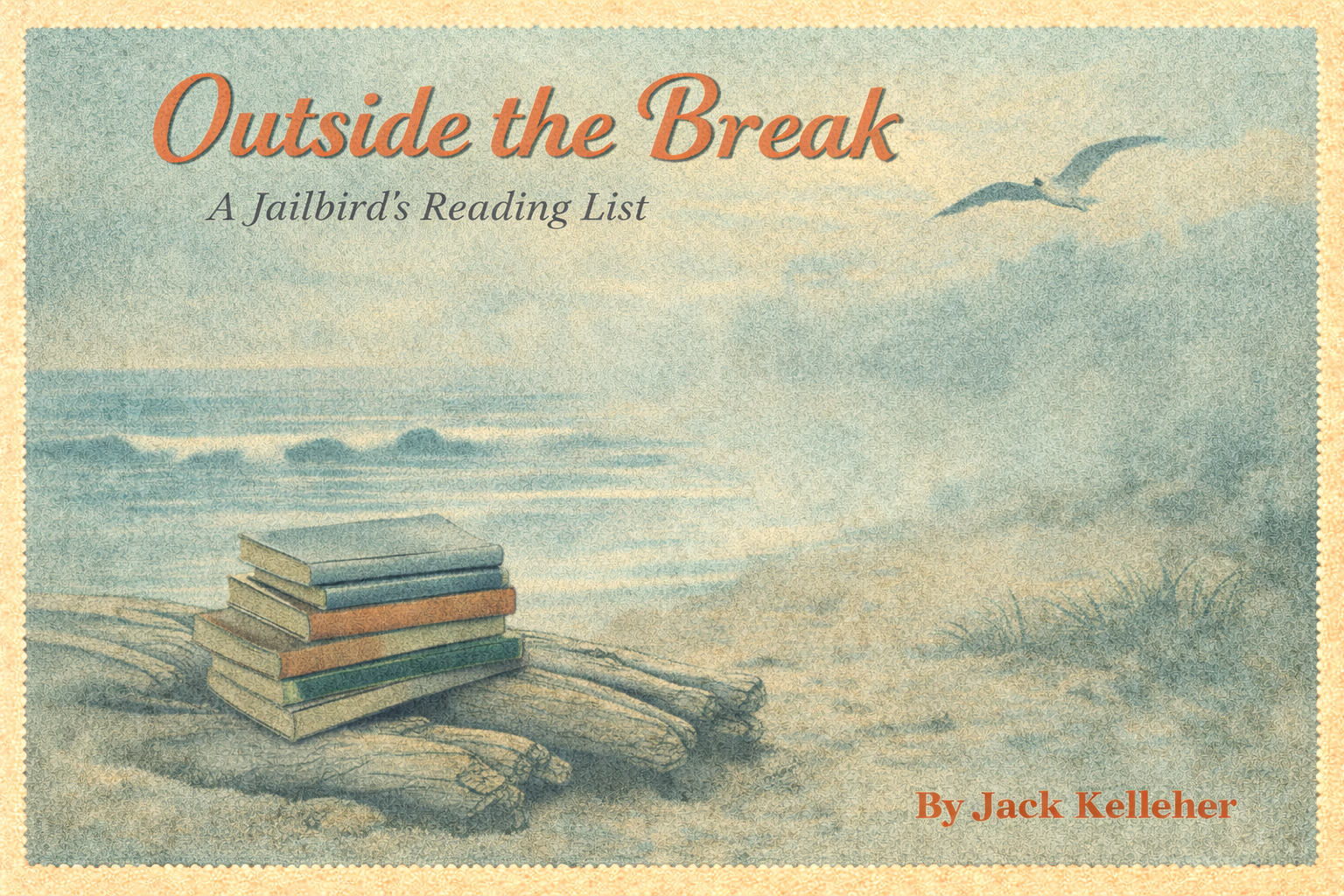
Here’s a reading list, books you might bring along to read if the surf’s blown out or you are: I’ve reviewed some of them.
1 Day
Satan’s Toyshop:
Wired for War by P.W. Singer
Penguin, 2009
Wired for War is a disturbing look at the use and potential use of robotics in combat. Singer interviews without editorial comment and focuses on the moral and ethical implications of machines at war, some of which haunt my nightmares. For instance, swarming killbots and machines which sustains themselves on battlefield leftovers, human flesh. This is not science fiction or perverse fantasy. It is all technology which existed when the book was published, more than a decade ago. We stand at the dawn of a new age, one where artificial intelligence, virtual reality, and quantum computers will forever transform our lives. Or maybe they will just eradicate us because they can.
Bronx Anthem
World’s Fair by E.L. Doctorow
Penguin, 1985
World’s Fair was my first E.L. Doctorow novel. It is part reminiscence, part history, and the rest plain magic. In it, you enjoy the prose artistry of the author as a mature and strong novelist, brim-full of sketches of life in New York City at the ragged end of the Great Depression and the dawn of the American empire. You see the world through the eyes of a Jewish boy on the cusp of manhood, taking his first wobbly steps into the future which the reader knows is fraught with peril. Nazi Germany is on the rise, England is at war, and in the Bronx, men gamble on baseball and spit tobacco juice in the dust beneath the bleachers. World’s Fair is a book which withstands time and deserves to be classed among the great American novels of the 20th Century.
Day 2
Newman’s Own:
Nobody’s Fool by Richard Russo
Random House, 1993
Paul Newman read Nobody’s Fool and telephoned its author, Richard Russo, asking permission to make a film. Newman knew a winner. Nobody’s Fool is a wonderful, loving look at small town America through the eyes of Donald ‘Sully’ Sullivan, deadbeat dad confronted with helping his estranged son navigate difficult times. Russo is a Pulitzer Prize winning author (Empire Falls) who somehow manages near anonymity, perhaps because his fiction is too much fun to be considered ‘literary.’ You’ll never forget his characters. The movie version of the same name (1994) won Newman an Oscar nomination and features Bruce Willis in his best role, Jessica Tandy (her last film), Melanie Griffith, and Philip Seymour Hoffman. Read the book and screen the movie. You’ll thank me.
Oops!
Collapse by Jared Diamond
Viking, 2005
Polymath Jared Diamond examines the disappearances of ancient civilizations such as those of the Maya, Anasazi, and Easter Islanders and compares them with more modern catastrophes, for instance, those of Haiti and the American state of Montana. He identifies and illustrates common causes for the fall of civilizations. By careful analysis, Diamond discovers the roadmap to chaos, carnage, and ruin. He then asks can we learn from his analysis. Although he tries to offer some hope for the salvage our own reeling civilization, he is unpersuasive at least to me. The current world health chaos only makes Diamond’s observations more ominous. If you suffer from anxiety anyway, forget about reading Collapse. Watch re-runs of The Big Bang Theory and drink tequila shooters. Nothing we do will make any difference. There are children playing grown-up in the command deck of the Starship Enterprise and they’ve locked the door.
Day 3
Broken Lance
The Song of Achilles by Madeline Miller
Bloomsbury, 2011
There is something wonderful about first novels, an electric charge we experience with the bursting out of a new, incredibly special voice. Madeline Miller’s scholarly and sexy retelling of the Iliad is such a novel. She gives us all the splendour of the Trojan War through the eyes of Patroclus, Achilles’ doomed comrade-in-arms and lover. I first read the Iliad in the Classics Illustrated comic book version sometime around 1950 and it hit me square between the eyes. Miller’s informed and excellent retelling did it again. I savoured every word. If you like it, read her follow-up novel, Circe, exploring the title character’s perspective on Odysseus and other playthings of the gods. Both novels take you away to the ancient world and a time when gods walked among us.
Get Greasy Today
Shop Class as Soulcraft by Matthew Crawford
Penguin (2009)
Philosopher-Mechanic Matthew Crawford makes the case for manual education; he argues the evolutionary human need to create with your hands. Crawford has a PhD in political philosophy from the University of Chicago and is distinguished in that arid realm, but he walked away from it away to become a motorcycle mechanic. He deplores that modern education has abandoned the manual arts, placing all its emphasis (and accolades) upon training to work in cubicles at treadmill jobs which provide no sense of tangible accomplishment. In doing so, it dooms the best and brightest to sunless lives of meaningless paper pushing and number crunching. Crawford tells us to drop out, pick up a spanner and fix something. That way you will have a good answer when asked ‘What did you do today?’ Tell ‘em you fixed an old bike.
Day 4 – Local Talent
Cliff Divers
Nice Girls Do Travel by Kathy Cuddihy, Amazon (2019), and
Quondam – Travels in a Once World By John Devoy, Amazon (2018)
West Cork writers Kathy Cuddihy and John Devoy were once adventurers, young people who stepped out of the queue and into the unknown. Like cliff divers, they took a deep breath and threw themselves into the void, counting on luck and timing to bring them safely home. Devoy cycled the length of Africa, Cuddihy hopped continents by boat, train, plane, and automobile, working her way around the world. Both memoirs tell of life on the road before cell phones, satnavs, and google maps; a time when wit might save your life. They travelled places where even landline communication was just a faint hope, sleeping where they could, making friends, and learning the ropes of yesterday’s world. I like memoirs, they have freshness and innocence not found every day. These are two of my favourites. Cuddle up in your favourite chair and travel back in time to places still unknown to most people. You’re travelling in good company.
Speaking in Tongues
Cloud Atlas by David Mitchell
Random House (2004)
Cloud Atlas is a splendid novel, well structured and beautifully written, taking the reader from 18th Century South Pacific to post-apocalyptic Hawai’i through interlinked narratives. It is such a good story that you can almost miss one of Mitchell’s signature skills. He creates a language, future English, and teaches it to us through his characters. He’s done this before in The Thousand Autumns of Jacob de Zoet, again meticulously, seamlessly. Cloud Atlas is a great story, one you might read again. Or, you could screen the 2012 Tom Hanks film of the same name. Both are intelligent and refreshingly different.
Day 5
The War
Blood, Tears, and Folly by Len Deighton
Jonathan Cape (1993)
World War II, universally called ‘The War’ throughout my early life, is a subject of some wonderful fiction, however, an enjoyable, informed non-fiction survey has always been lacking. Great man biographies abound, but how can we put them into context? Just how does it happen that England won the war and lost an empire, American came in late and gained an empire, and Europe’s ruins would spawn a powerhouse new union? America dropped two atom bombs on Japan, and they became best mates, allies and economic partners. Did I miss something when I went out for popcorn? What was The War all about? As it turns out, spy novelist Len Deighton is an avid amateur historian and considerable authority on World War II. Deighton’s Blood, Tears, and Folly is the best modern history book you will ever read. Sometimes it is so good you’ll forget it’s not fiction.
Cocooning Soviet Style
A Gentleman in Moscow by Amor Towles
Penguin (2019)
Count Alexander Rostov, convicted in 1922 by a Bolshevik tribunal of being an unrepentant member of the nobility, is sentenced to lifetime house arrest in the Hotel Metropole, across the street from Kremlin, thereby becoming witness to some of the worst times in Russian History. How does a person accustomed to life in the grand style cope with one more suitable for a starving artist? How does a man of wit, intelligence, and sensibility endure isolation in Stalinist Russia? This is Towles second novel, his first, Rules of Civility, was a bestseller. It is a witty, wise, and funny book which teaches a serious lesson along the way, a soaring testament to the human spirit. A Gentleman in Moscow is beautifully written. Enjoy.
Day 6
Motorcycle Odyssey – Life Tartar
Setting Free the Bears by John Irving
Random House (1968)
Setting Free the Bears, the story of two boys’ motorcycle odyssey across post-war Austria, is Irving’s debut novel and, by most critics’ lights, it is a rough start. However, if you have loved any of Irving’s later work, you will see his genius struggling to break out here. And, I disagree with the initial reviews, Setting Free the Bears is a solid novel, fun, chock full of Irving’s signature bizarre nostalgia, quirky sex, and unintended consequences – the muddle of life tartar. John Irving and I are the same age and began our careers in the same year. Maybe I like his novels because they have been my companions along the road.
Washing Up After the Feast
The Paris Wife by Paula McLain
Ballantine Books (2011)
I have a fondness for fictionalized history, stories based on solid research and educated supposition, the probable truths of some unknowable lives. Michael Shaara’s American war ‘histories’ are the best examples. The Paris Wife is Paula McLain’s contribution to the genre. McLain wrote the story as a counterpoint to Hemingway’s A Moveable Feast, his nostalgic memoir of the artists life in 1920s Paris. McLain’s is the same story told from the perspective of Hadley Richardson Hemingway, his first wife, the woman he betrayed and abandoned for her best friend, Pauline Pfeiffer, the second of Hem’s four wives. If you are interested in the times which marked the lives of a generation of American writers, The Paris Wife is ‘must read.’ It is a loving look at a lost summer crossroad when everyone danced, but some were left to pay the fiddler.
PS: If the times interest you, read Z, A Novel of Zelda Fitzgerald (2014), by Therese Anne Fowler, another excellent read. It became a television series
Elvis and Yo-Yo Ma
Day 7 – An Essay on Short Fiction by Jack Kelleher
The short story is as different from the novel as both are from poetry. A short story is a rollercoaster ride, the novel a journey on the Orient Express. Short fiction shares a musical gene with poetry. Poems were once chanted by travelling minstrels. Short fiction has rhythm and sometimes melody, a message embedded in the words that carry it. It also has national characteristics, Irish stories are different from those of North America, Spain, and Russia. The stories of Anton Chekov are as distinct from those of Ernest Hemingway as is the music of Elvis Presley from that of Yo-Yo Ma. You experience a great short story in your heart and in the pit of your stomach. You may shed tears or laugh out loud. Or, just be relieved to be off the hook.
Short fiction has evolved since Mario Puzo sang of blood and guts at Anzio Beach and Stephen King wrote ‘The Revenge of Lard Ass Hogan.’ With television’s murder of everyday literacy, short fiction has holed up, cocooning behind academic walls. Its faint heartbeat subsists on life support, grants and bursaries. Yet it persists.
I expect a break-out, a re-emergence of the short story as everyday entertainment. I see flickers of this in audio books, popular television (Black Mirror, The Twilight Zone), and video games (Call of Duty, Resident Evil). In tomorrow’s world I foresee short stories accessible by android phone, giving us a wormhole away from the ubiquitous televised rubbish in medical surgeries and airports lounges. I dream of stories sung in virtual reality, graphically illustrated by artificially intelligent quantum computers.
So, here’s to the short story. May it live so long as people want to hear ‘a good one’ from somebody who likes to tell a tale, even if that somebody is no longer fully human.
Starting Suggestions:
Reunion, John Cheever
Waiting for the Bullet, Madeline D’Arcy
Hills Like White Elephants, Ernest Hemingway
Walk the Blue Fields, Claire Keegan
The Perfect Wave, Jack Kelleher
The Horse Dealer’s Daughter, D.H. Lawrence
El Llano in Flames, Juan Rulfo (Beechinor Translation)
The Eighty Yard Run, Irwin Shaw