
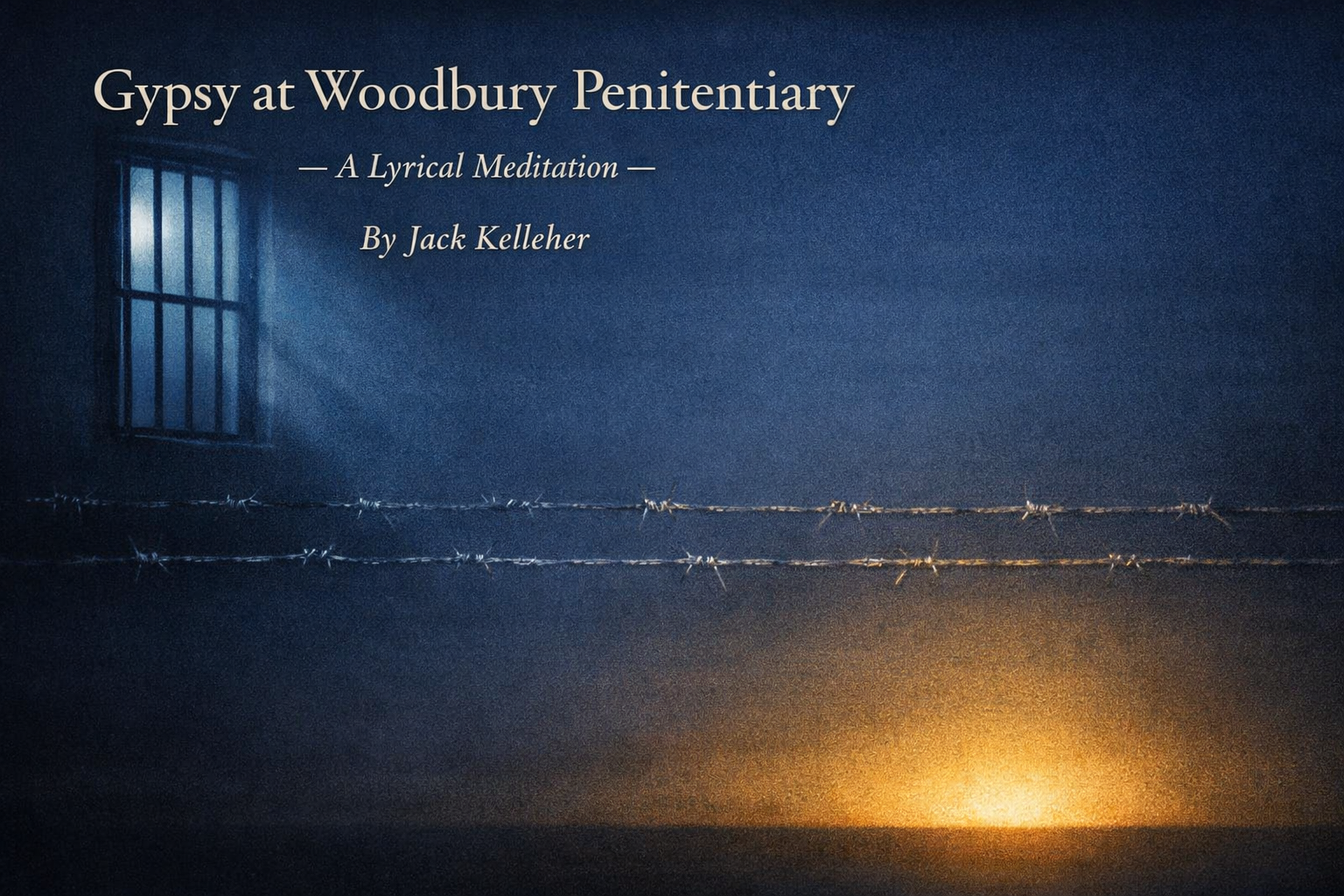
Prison Sounds at Woodbury
The Federal penitentiary at Woodbury sang its own song. It was an experimental “meditational prison,” with rules encouraging a quiet, cloistered life.
Mornings began with a hollow clang — not quite a bell, rather the sound of a heavy steel door striking against its own echo. Then came the shuffle of boots and slippers on the corridor floors, a soft tide of movement toward the mess hall. Coffee urns hissed, trays clattered, someone laughed too loud and was instantly hushed.
By midmorning the building had settled into its hum: typewriters from the education room, the thump of basketballs in the yard, the rasp of a broom on concrete. A transistor radio somewhere down the hall played instrumental music in a hypnotic beat looping through static. Inmates spoke to each other with the practiced rise and fall of men who knew the rules, honoured the silence.
At noon the bell rang for count, a jarring firehouse clang that flattened the whole landscape. Silence followed — deliberate, weighty, almost devotional. Then voices again, low and steady, as the guards checked each name against the list.
Evenings were gentler. From the chapel came the hesitant chords of a piano, someone learning scales; from the rec room, the muffled laughter of a movie crowd; from the laundry, the endless mechanical sigh of driers. At 8:30 a train passed in the valley below, its horn at the level crossing bending like a note in a blues song. Men would pause in their conversations, listening for the echo.
At night, the building breathed. Pipes ticked. The night guard’s measured footsteps marked time like a clock no one could see. Somewhere far off, a door shut with finality. Then only the hum of the fluorescents and the soft cadence of sleep — time looping again, patient as faith.
Jim flicked on his desk lamp and opened his school folder. He had an essay to write. Pausing, he thought Woodbury really was a country club, although constructed to look like a classical big-house prison. The lawns were clipped, the Hudson shone below the bluff, and the men inside wore khaki instead of denim. But it was still a cage, even if the bars were polite.
Gyp Lawson had been there nine months when the college day-furlough program was initiated. The inmates teased him about “rehabilitation through homework.” He signed up for Music Appreciation mostly because the counsellor said the instructor was easy, some adjunct from SUNY who graded on enthusiasm. She also was nice looking, had a sweet smile.
Now, sitting at his metal desk in the yellow cone of his lamp, Gypsy hunched over the page like a penitent scribe. The smell of disinfectant and instant coffee hung in the air. From the next cell came the whisper of someone’s radio — a jazz groove looping like a heartbeat behind concrete.
He began the essay the way he always started letters: slowly, with a moment’s stillness before committing pen to paper. The topic was supposed to be “Compare and contrast Booker T., Toots, Pärt, and Glass.” But what Gypsy really wanted was to write about time — how it doesn’t pass in prison, it circles. The groove, the chant, the drone. The way every day looks like the last until you start to hear the beauty in sameness.
He wrote the title Prophets of the Loop – Repetition as Revelation, underlined it once, and smiled faintly. Out in the yard a night bird called. He thought about men moving around the prison like notes in a scale. Gypsy started writing, as if the act itself could keep the world turning.
***
Music Appreciation 101 — Optional Essay Question
Compare and contrast the works of Booker T. & the M.G.’s, Toots and the Maytals, Arvo Pärt, and Philip Glass. Refer particularly to “Louie Louie,” “Green Onions,” and “Spiegel im Spiegel.” Word limit: 750.
Prophets of the Loop – Repetition as Revelation
by J. Lawson
I. Green Onions and Groove Theology
Booker T. Jones was barely out of high school when he found the riff that wouldn’t quit. “Green Onions” (1962) is little more than a twelve-bar blues in G minor — simple, repetitive, and absolutely alive. Yet each cycle deepens the trance. Steve Cropper’s guitar flicks like a match head; Donald Dunn’s bass prowls in tight circles; Al Jackson Jr.’s snare speaks in discipline. There’s no melody in the classical sense, only a vibe — a sanctified hum out of Memphis.
Repetition here isn’t laziness. It’s ritual. Each chorus reaffirms belonging — the band tight as a heartbeat, the groove its breath. In three minutes, Booker T. teaches what Arvo Pärt would later express in sacred stillness: that iteration, sincerely played, can be prayer.
II. Toots and the Maytals: Louie Louie in Jamaica
If “Green Onions” is the sermon, Toots Hibbert’s “Louie Louie” (1972) is the revival. Borrowing Richard Berry’s garage anthem and transplanting it to Kingston, Toots turns ragged repetition into freedom. The song chugs like a diesel bus, offbeat guitars skanking beneath his bright exhortation: Louie Louie, oh no, I said we gotta go.
Each refrain is both the same and different — swung, syncopated, and joyous. What Glass achieves through structure, Toots achieves through heartbeat. The loop becomes laughter. Repetition becomes emancipation — the sound of a people shaking off predictability and dancing into their own time.
III. Arvo Pärt and the Bell of Silence
Far from the Caribbean, Estonian composer Arvo Pärt listens not for rhythm but for silence. In “Spiegel im Spiegel” (1978), he offers a piano arpeggio and a violin line that rises and falls like breathing. Nothing happens in the usual sense, yet everything happens.
Each phrase mirrors the last, but never identically; a note lingers, an interval opens wider. Time ceases to move forward — it becomes devotional. Pärt calls this method tintinnabuli, the bell-like purity of interlocking tones. What Booker T. did for the body, Pärt does for the soul. Through stillness and recurrence, we glimpse infinity — a sound that refuses to hurry, that trusts us to hear the divine echo inside monotony.
Sidebar: From Poe to Pärt — The Music of Bells
Long before Arvo Pärt coined tintinnabuli, Edgar Allan Poe struck the same bell in words. In his 1849 poem “The Bells,” Poe invented the term “tintinnabulation” to describe the ecstatic ringing of sound itself — “keeping time, time, time, / in a sort of Runic rhyme.”
Both artists hear revelation in repetition. Poe’s verse turns language into a carillon, chiming until the ear begins to hallucinate music. Pärt’s tintinnabuli does the reverse: sound becomes prayer, each tone a syllable in a wordless poem. Across a century, they share one intuition — that by striking the same note again and again, we awaken the listener’s own harmonic soul.
IV. Philip Glass: The Machine Learns to Dream
If Pärt is the monk, Glass is the engineer. In Einstein on the Beach (1976) and Glassworks, he builds vast architectures of pattern and pulse — ostinatos stacked like gears. Yet beneath the mechanism flows emotion, like water through machinery.
Glass’s repetitions are architectural: rhythm upon rhythm, until the listener stops counting and begins floating. Spiegel im Spiegel invites us inward; Glass propels us outward, into the kinetic world of light and motion. His music shows that even modern machinery can pray.
V. The Moral of the Loop
What unites these four — Booker T., Toots, Pärt, and Glass — is their belief that repetition can be revelation. The groove, the chant, the drone, the cycle — each invites the listener to stay a while, to listen again.
Repetition becomes revelation when we stop waiting for change and begin hearing presence. Whether it’s the M.G.’s laying down the eternal bar, the Maytals chanting their freedom, or Glass and Pärt teaching us to inhabit time instead of escape it, all four are prophets of the loop.
Music, like life, rarely needs to move forward to move deeper. Sometimes the circle opens only when we stop trying to leave it.
***
Lights out, and Gyp puts down his pen.
Woodbury at Night
After lights-out, the prison took on a strange clarity. The floodlamps along the inner fence threw long shadows across the yard, lattices of wire trembling on the walls. Beyond the perimeter, the Connecticut hills lay in darkness, a deeper silence than the institution could ever manage. Gypsy used to watch the trees shift in the wind, their branches ghosting through the mist. Some nights he imagined he could smell rain coming off the river. Sometimes the guards lit up the old tower lights, but only to catch the dance of snowfall in the moonlight. Nobody lucky enough to stack time at Woodbury wanted to risk it by scarpering.
From his window — a narrow slot with bars too thick to matter — he could see the tower lights, pale yellow and steady. The guards up there were only silhouettes, slow-moving figures against the glow, as if pacing the rim of a dream. The yard lamps burned all night, but the colour drained out of everything; the basketball court looked like wet slate, the chapel cross like a shadow of itself.
Sometimes, in that half-silence, a voice would carry — a guard calling the hour, a restless inmate muttering a prayer or a joke. The echoes stretched and folded, as though the walls themselves were listening. Far below, a single radio might still be playing faintly — soul music, something circular and forgiving. The tune would fade, come back, fade again, looping in the dark. Gyp was glad radios were permitted at Woodbury.
When the moon was full, its light pooled on the roof of the workshop and glinted off the barbed wire like thin silver handwriting. Gypsy thought it looked almost beautiful — the world’s cold poetry written in metal. Then the clouds would roll in, and the place would disappear again into itself, holding its breath until morning.