
By Jack Kelleher
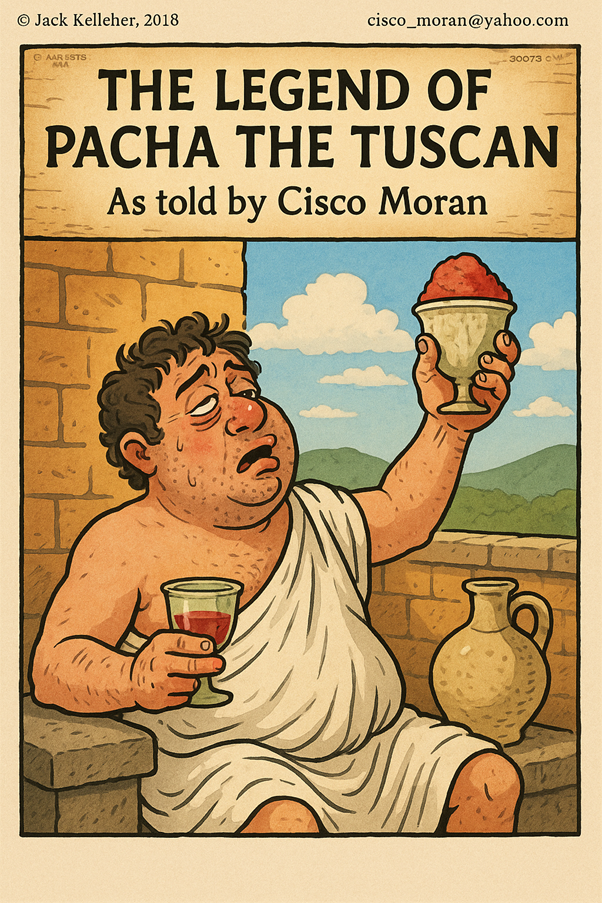
On one blistering afternoon, Pacha lounged on his piazza just outside the city wall. His toga was uncomfortably tight, his head throbbed from the sacred revels of the night before, and he was working on his third grappa.[3] He flavoured it with strawberries and drank from alabaster cups so finely worked that, when lifted to the light, the fruit’s colour glowed through.
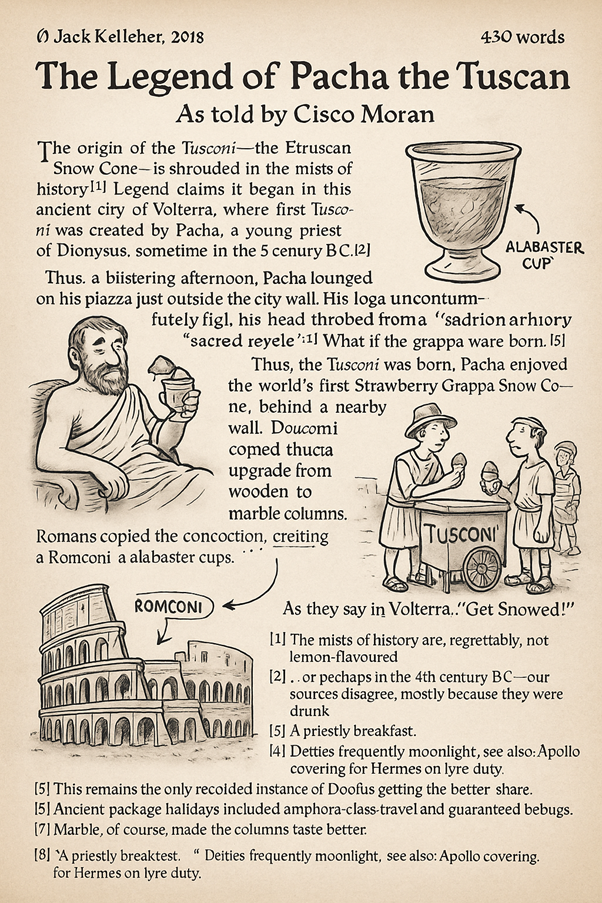
The origin of the Tusconi—the Etruscan Snow Cone—is shrouded in the mists of history.[1] Legend claims it began in the ancient city of Volterra, where the first Tusconi was created by Pacha, a young priest of Dionysus, sometime in the 5th century B.C.[2]
At that precise moment, inspiration descended like a thunderbolt from Zeus (moonlighting for Dionysus).[4] What if the fruit and grappa were poured over shaved ice, fetched by his faithful Siennese servant, Doofus?
Thus, the Tusconi was born. Pacha enjoyed the world’s first Strawberry Grappa Snow Cone. Behind a nearby wall, Doofus rapidly consumed the second and third.[5]
The secret soon spread. Pacha told Lucre Causa, the High Priest, and together they began selling Tusconi from a pushcart in Volterra’s Saturday Market. Romans on package holidays [6] flocked to it. The temple coffers swelled, enabling the clergy to upgrade from wooden to marble columns.[7]
The Romans, as always, copied and commercialized. They launched the Romconi—a Grappa Slushy, mass-produced and inferior, but wildly popular. In the Forum, it dulled the citizens’ tedium during endless speeches. In the Colosseum, a mini aqueduct delivered Romconi to the crowd, and even to gladiators between bouts of killing each other.[8]
Today, a true Volterran Tusconi is still served in alabaster cups, available to lucky travellers who happen upon a modern practitioner. The cups may be taken home, allowing you to continue the sacred tradition in your own kitchen.
As they still say in Volterra: “Get Snowed!”
Footnotes
[1] The mists of history are, regrettably, not lemon-flavoured.
[2] Or perhaps in the 4th century B.C.—our sources disagree, mostly because they were drunk.
[3] A priestly breakfast.
[4] Deities frequently moonlight; see also: Apollo covering for Hermes on lyre duty.
[5] This remains the only recorded instance of Doofus getting the better share.
[6] Ancient package holidays included amphora-class travel and guaranteed bedbugs.
[7] Marble, of course, made the columns taste better.
[8] “Win or lose, you still snooze,” as the gladiators allegedly chanted.