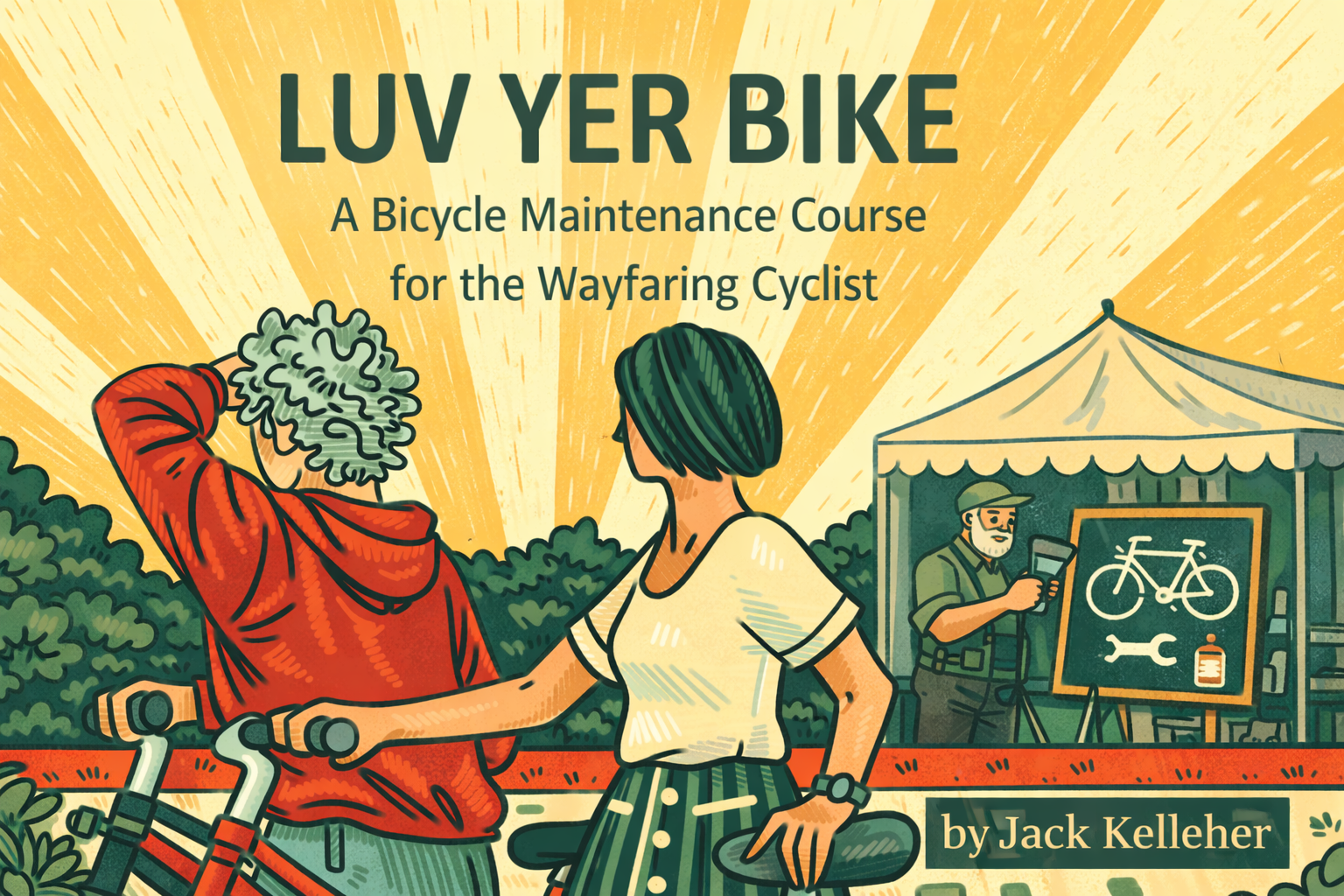
The Pushbike’s Companion
A Bicycle Maintenance &
Safety Workbook
By Jack Kelleher
Cover Art by Lavena Edelton
Lesson #1
About Bicycles
Vivre La Bicyclette Une Amie De L’Homme
Introduction:
Think about freedom of movement.
Bikes as Freedom Machines – The Star-Bike Enterprise
History and Development of the Bicycle:
Visualise Cork City in 1800 – No improvement in everyday life since ancient times. Poor people walked barefoot in the mud, rich rode in horse drawn carriages. Everyone lived ankle deep in manure. Eighty years in the 19th century changed all that forever.
1815 Mount Tambora (Indonesia)
1815 Steel Tubing – Demo
1817 Karl Von Draise – The Draisine – German
1856 Henry Bessimer – Steel Mass Production
1869 Jules Surray – Radial Ball Bearings – French – Demo
1869 James Moore Wins 1st Bike Road Race (Paris – Rouen)
1885 Starley’s Safety Bike, the Rover.
1888 Pneumatic Tyres – Dunlop in Belfast
1895 Loubeyre Derailleur – French – Demo
Cycling & Women’s Rights: In 1850, Amelia Bloomer, founder of ‘The Lily’, the first women’s publication, invented ‘Bloomers’. Bloomers made women’s cycling possible within the modesty norms of the 19th Century. Women were attracted to the new freedom of dress and the new freedom of cycling in the latter half of the 19th Century.
‘ ‘Sew on your own buttons, I’m going for a ride’
Types of Bikes Today:
Balance Bike – Draisine still alive.
Spandex Racers
Downhill Dirt Insanos
Hipsters on Folders
Ebikes & Assistive Bikes
Municipal Rental Bikes
Cargo Bikes & Kid Haulers
Why Learn to Fix Bikes:
Have true Freedom of the Road.
Always Have a Plan B
Learn Basic Mechanics – Gateway Skill Set
Shop Rules – Life Rules – Shop Rules Handout
Manual Work Is Innate in Humankind – Feed Inner Neanderthal
Recommended: Crawford, Shop Class as Soulcraft.
So you can say, ‘I can fix that.’
Examine A Bike – Learn to Really Look at A Bike
` Learn critical analysis as a life skill – full stop.
What is it for? Does a particular bike have any realistic utility for you?
A Suite of Tools – Start Making Your Own List.
Taking A Bike Down to The Bones – Cleaning & Evaluating as You Go.
References & Handouts
YouTube: Building A Bicycle – 1945
Handout: FolkBike Challenge (Appendix)
Handout: Workshop Rules at The Bike Circus (Appendix)
Crawford, M. Shop Class as Soulcraft
Break
Degrease Sample Bikes
Lesson #2
Vee Brakes
I make cars go, not stop!
Enzo Ferrari
Notwithstanding the late Commendatore’s frustrated remark, stopping is very important. For purposes of time economy, we’re limiting this discussion to the Vee Brake. It is most ubiquitous in today’s cycling. We’ll demonstrate service of this hardy brake and comment on other types when and as our actual maintenance work presents them.
| Nb. Mounting bolt pivots on a brass shim which requires lubrication and regular service. |
Brake Actuation – Levers:
| Brake levers all pivot on a pin which also requires regular check-up and lubrication. |
Cable Pull & Hydraulic Actuation:
Cable pull is still the predominant technology. As electric bikes enter the market, hydraulic disc brakes may well eclipse them. Disc brakes are heavier and hydraulic systems more complicated, however they provide excellent, all-weather braking.
Brake Maintenance:
Annual cable replacement and brake surface inspection is recommended. Brake blocks can become oxidized making them ‘woody’ and less functional. It is also important to check wheel rim wear. Over time, rims wear thin and in the worst scenario they can collapse at speed when the cyclist applies the brakes. This is particularly a problem with smaller wheels, for instance, Brompton and other folders.
Primary Tools:
Cable Cutters
Needle nosed pliers (locking handy)
Star Spanner/Allen Key
‘Third Hand’ Tool
Lesson #3
Bearings
Jules Suriray, a Parisian bicycle mechanic, designed the first radial style ball bearing in 1869, which was then fitted to the winning bicycle ridden by James Moore in the world’s first bicycle road race, Paris to Rouen, in November 1869.
Development of Bearings:
Wooden Shim Bearings – Lubricated with Animal Fat.
Metal Shim Babbitt Bearings – Typically Brass or Other Soft Metal. You’ll find these on Vee Brakes.
Steel Roller Bearings – Lubricated with Petroleum Grease
Radial Bicycle Wheel Bearings
Bicycle sealed bearing bottom bracket. Note plastic retainer ring on left. – Disposable, viz., not repairable.
Tools:
Cone Spanners
Box/End Spanners
Magnetic Pointer
Magnetic Cleaning Dish
Cookie Sheets or Trays
Degreaser (White Spirit)
Lesson #4
Power Transmission – Cogs, Chains, & Gears
| Cross section of bicycle wheel and tyre showing clincher tyre clenching the rim. |
Bicycle Chains:
‘Hey man, if this is torture, chain me to the wall.’
Cheech Marin as
Tito, ‘Oliver & Company’
History:
First known power transmission chain is Chinese from about year 1000 ME. Used to draw a crossbow. Became a primary bicycle component with the introduction of the modern, safety bicycle in late 1880s supplanting the direct drive ‘Ordinary’ bicycle.
Types of modern chains. Importance of length measurement when replacing.
Drive belts and the future of power transmission for eBikes.
Manufacture:
YouTube Video: ‘How Bike Chains Are Made’ https://www.youtube.com/watch?v=h8j5-dC6_x8
Wear Checking:
Almost a non-issue with old single speed bikes, but very important with modern, ‘whippy’ chains. A worn-out chain will damage your chain ring and cassette/freewheel by wearing out the teeth, giving them ‘shark tooth.
Chain Gauge, a wear-checking tool.
Cleaning:
Should be part of your regular maintenance and is absolutely necessary after chain is soiled by mud or sand. No matter how you do this, it’s a dirty job. The chain scrubber does it best and quickest, but don’t attempt this in your living room whilst watching television with your spouse. Thar be dragons, matey! A toothbrush and white spirit will do the trick.
Lubrication:
Petroleum based lubricants are best in most circumstances and last the longest. Higher tech, non-sticky silicon-based lubricants are fine, but require more frequent attention. Nb, WD-40 is a desiccant, not a lubricant and, if used, a lubricant is necessary too. For general use in West Cork, I prefer GT-7. Its low temperature delivery removes rust scale while lubricating.
Removal & Installation:
Use and care of a chain breaking tool.
Chain pliers and quick link removal and installation.
YouTube Video: ‘How to Replace a Chain’
Toolbox:
Chain Gauge
Chain Scrubber
Chain Pliers
Chain Breaker
Bicycle Derailleurs – Mechs & Levers
Strange visitors from Planet Gearhead.
History Moment – Bicycle Shifters – A Case Study in Overdesign.
A shifter’s job is simple, pull in and feed out a line of cable to change the position of one or more derailleurs thereby adjusting the power train to meet the cyclist’s wishes. The derailleur has an opposing spring which pulls the cable and ‘tries’ to shift into the highest (smallest) cog on the freewheel. This spring pull is integral to how all shifters work.
Thru the 1970s, all shifters were friction shifters, leavers which pulled or released the shifter cable. They were held in position by friction and worked very well with a little practice. They had one moving part. Friction shifters require that the cyclist take one hand off the handlebars to manipulate the lever. Neophytes were hard to attract to cycling because of this learning threshold.
In the 1980s, Shimano invented the rachet shifter which made possible shifting devices which could be thumb or otherwise actuated without taking your hands off the bars. The twist grip shifter, which displayed the selected gear numerically took cycling by storm and, since then, shifters have become increasingly complex mechanically, but unchallenging to operate.
The most complicated shifter we encounter, the ‘command deck’ or ‘brifter’ variety, has more than one hundred pieces and is practically beyond repair. Electronic shifters are a separate study and beyond our ambition.
Friction Shifters – One Moving Part
Ratchet Shifters – Many Moving Parts
Deraillers (Mechs):
| Rear Mech – Parallelogram Derailleur |
Terminology: Adjuster Barrel = Indexer
Adjustment Screw = Limit Screws
Guide Pully = Pilot Wheel
Tension Pully = (Unnamed Above)
B Screw = Mech Attitude Adjuster
Chain wheel (aka chainring) and freewheel or cassette. Cassette refers to a freewheeling mechanism which is integral with the rear wheel.
Shifter levers & specialized teeth on sprockets – sprockets are not gears. Gears mesh, sprockets are interconnected by a chain.
What makes it all work?
The laws of physics – momentum and centrifugal force. That’s why pedalling while shifting is so vital. The chain must be supple and in motion for it all to work as a system which ultimately derives its energy from the cyclist.
Worth reading: https://en.wikipedia.org/wiki/Derailleur_gears
http://classiccycleus.com/home/shifting-times/
Lesson #5
Rolling Magic – Wheels
Hubs, Spokes, Rims & Tyres
Bicycle Wheels:
A bicycle wheel is a working suspension system composed of hub, spokes, rim, tube, and tyre. If any component of the system is compromised, you should dismount and repair it or walk your bike home. Think of the wheel as a suspension bridge. Would you drive across the Brooklyn Bridge if one of its cables were snapped? You should check for tyre pressure (written on the side of every tyre) and spoke integrity at least weekly. Within limits, spoke tension is not critical so long as all the spokes are roughly the same. The process of building a wheel from a pile of spokes is called ‘lacing’. Many people find lacing restful and meditative, akin to crocheting and needlepoint, something to do with their hands while watching television. Some hand laced wheels are truly elegant.
| Cross section of bicycle wheel and tyre showing clincher tyre clenching the rim. |
Exercise: Remove and replace a broken spoke.
Demonstrate Puncture Repair- As Easy As 1, 2, 4!
First: Verify that tube is punctured. Many ‘punctures’ are failures to
keep tyre inflated in storage.
Second: Inspect the tyre for foreign objects. What made tube go flat? Look inside and out. Check wheel rim tape.
Third: Dismount tyre by putting tyre iron between the wheel rim and tyre bead, then prying the tyre off. The tyre bead is typically steel or Kevlar, both stretch under firm, even pressure. Pull tube gently out of tyre.
Fourth: Locate and mark leak with chalk. Rough-up patch zone with sandpaper and apply a modest amount of contact cement. Then wait five minutes for glue to dry before applying patch. Rub the patch down with a smooth-sided tool to work out any bubbles.
Glue Drying Time Measurement Device
Success!
Risky Courtship with Bicycle & Mandolin
Lesson #6
Streetwise Cycling:
M Check, Safety Equipment,
& Mindfulness
M Check & Wipe Down Your Bike Weekly!
A Clean Bike Is A Safe Bike!
- Tyre pressure, spokes, wheel bearings and front brake callipers.
- Headset & brake levers
- Bottom bracket, pedals, & front derailleur (mech).
- Saddle height & security, rear brake callipers.
- Rear derailleur (mech), tyre pressure, spokes, and wheel bearings.
Wipe down bike with clean shop rag and white spirit while you inspect it. If anything is wrong, fix it. If you can’t, bring it to the Bike Circus and we’ll show you how.
https://www.youtube.com/watch?v=V7I1clyfhos London Bike Kitchen
Safety Equipment:
Helmet: Unfortunately, helmets have become something of a political hot-button among cyclists. Cyclists don’t like to be told they must wear equipment by anyone, let alone by people who aren’t cyclists or even our friends. Still, I personally wear a helmet and recommend it to all without regard to age or style of cycling.
| Minimalist Headgear. Nb., the visor. It’s functional. |
Gloves: Gloves protect your hands, cushion the bars, and are a boon in saving your face from roadside brambles. They also keep ageing knuckles warm when the weather cools.
Hi-Viz Vest: Being seen is half the battle on the open road, particularly in Ireland’s narrow, sinuous little boreens. One could try cycling naked save for a top hat but in the long run a high viz vest is warmer and it’s always best to keep a few secrets. Most car drivers would really rather not hit a cyclist however attired if for no better reason than it would damage the grille of their new BMW.
Accessories:
Bells are required in many jurisdictions and are a friendly way to ask pedestrians to allow you to pass safely. We also use bells to greet others with whom we share the road. Lash out, get a fancy bell and use it just for fun!
Lights – I don’t recommend cycling after dark but I do use flashing front and rear lights to increase visibility in reduced lighting. Modern lights are elegant kit, often rechargeable, and provide excellent lighting.
Safety notes, if you don’t use an accessory take it off your bike. Loose stuff can bring you grief. Be careful of where and how you attach locks and panniers. Do not permit them to compromise any bike system, most particularly the brakes.
Benediction
Mindful Cycling:
I have been bicycling for more than seventy years. I ride a bike for the love of it and have never viewed cycling as a fitness or mental health regime. Rather, a bike has been my freedom machine, a portal to a place where the colours are brighter, the breezes cool, and sunshine warms my back. When I’m cycling, I am disconnected from daily cares. And I am intimately connected to the world around me.
The pace of cycling is perfect to experience the world thru which you pass; just fast enough to ruffle your hair. I cycle mindfully, fully in the moment, hardwired to my bike and our surroundings. Other road users, their needs and intentions, play across my consciousness like a news ticker. I want to accommodate them and make our encounter safe, seamless, and friendly. I am a cycling ambassador, not a soldier. I share the road and never ride aggressively. I urge you to do likewise, accepting and accommodating what comes your way. You’ll be glad you did.
I enjoy traveling alone, wondering what awaits me over the next green hill. Perhaps I’ll meet a new friend in some crossroads inn. Maybe I’ll get an idea for a story to tell. Or I might just sit in the dunes beside a wee fire, play my tin whistle, and sleep among the stars. There is much happiness to be found on one’s own. That said, if you have a companion with whom you share the road, relish their company. If you share your adventure, however, be sure to travel with someone you love. Leave your troubles behind.
I suggest that you savour cycling, not bolt it down. Have you ever walked along an empty beach in the company of an old lover or dearest friend? Every step is a moment which will pass but which you wish would last forever. This is how you should approach cycling whether commuting in the Dublin rain or exploring wild Donegal. Savour life, savour cycling, let them bring you joy.
There is a great tradition among long riders to pause and chat, sharing information about the roads you’ve wandered and adventures you’ve found. Part of this experience is to offer help and encouragement to other wayfarers. There may be a reason why someone has come into your life. Look for it and be generous with your time and assistance. You’ll be surprised what joy this will bring.
Above all else, live free and live now!
Keep on bikin’,
Jack
The End
Appendix
Relax, You Can Fix It At
Yard Safety
~
The 12 Commandments of Tool Care, Etiquette, & Ethos
- Use workstand and ask for help mounting bike.
- Keep stands apart and respect other’s workspace.
- Keep workspace tidy and tools orderly.
- Never ground a tool. It disrespects what we do.
- Wear work gloves, ear and eye protection.
- Know location of fire extinguisher and first aid kit.
- Use the proper tool for the job.
- Avoid adjustable spanners and pliers.
- Avoid excessive force and power tools.
- Unplug/store power tools immediately after use.
- Ask before you take a tool from another’s workspace or toolbox.
- Wipe down, sanitize, and return tools to cabin at job’s completion.
- Don’t ‘share’ your temper or frustration. If you’re having a bad day walk away, sit in the sunshine, and recalibrate. Chat don’t work on bikes.
- Share interesting problems, develop mutual respect and collegiality.
- Have fun! Laugh, share music, and bike news.
- Remember: We are a civic amenity; our mission is inclusive. Greet and help all visitors, projecting warmth and interest. Keep ‘em bikin’.
The Bike Circus’ FolkBike Challenge
€300 Grand Prize
The Concept: The world needs a reliable, durable, and easily serviced everyday bike; a freedom machine and bike for all seasons.
The Challenge: Can you build this bike from readily available components, preferably salvaged from skips, cardboard boxes under your bed, and recycling yards?
Suggestions: The FolkBike is meant to be comfortable, safe, and utilitarian. A secure rear rack is essential. Drive-train simplicity is also critical. Be prepared to defend the choices you make here – single speed, rear derailleur, or internal gear hub? Drive belt or chain? Twist, thumb, or friction shifters?
Are the components serviceable? For instance, are the pedals ‘use and lose’ or capable of lasting a lifetime with periodic service? Can your bike be serviced by the side of the road with a handful of everyday tools?
Ebike adaptable? The FolkBike is a pack mule and daily commuter. It should be readily adaptable to children’s seats and electric assisted power.
Elegance and eye appeal are important. Paint your bike, polish its bright work, install a fancy ding-bell. Add a flower holder on the front bars. Recommended reading, How to Build a Bike, by Jenni Gwiazdowski, available at Amazon. Viewing, Breaking Away (1979). For terms and conditions and further information contact Jack, cisco_moran@yahoo.com.
In Velo VeritasThe Pushbike’s Companion
A Bicycle Maintenance &
Safety Workbook
By Jack Kelleher
Cover Art by Lavena Edelton
Lesson #1
About Bicycles
Vivre La Bicyclette Une Amie De L’Homme
Introduction:
Think about freedom of movement.
Bikes as Freedom Machines – The Star-Bike Enterprise
History and Development of the Bicycle:
Visualise Cork City in 1800 – No improvement in everyday life since ancient times. Poor people walked barefoot in the mud, rich rode in horse drawn carriages. Everyone lived ankle deep in manure. Eighty years in the 19th century changed all that forever.
1815 Mount Tambora (Indonesia)
1815 Steel Tubing – Demo
1817 Karl Von Draise – The Draisine – German
1856 Henry Bessimer – Steel Mass Production
1869 Jules Surray – Radial Ball Bearings – French – Demo
1869 James Moore Wins 1st Bike Road Race (Paris – Rouen)
1885 Starley’s Safety Bike, the Rover.
1888 Pneumatic Tyres – Dunlop in Belfast
1895 Loubeyre Derailleur – French – Demo
Cycling & Women’s Rights: In 1850, Amelia Bloomer, founder of ‘The Lily’, the first women’s publication, invented ‘Bloomers’. Bloomers made women’s cycling possible within the modesty norms of the 19th Century. Women were attracted to the new freedom of dress and the new freedom of cycling in the latter half of the 19th Century.
‘ ‘Sew on your own buttons, I’m going for a ride’
Types of Bikes Today:
Balance Bike – Draisine still alive.
Spandex Racers
Downhill Dirt Insanos
Hipsters on Folders
Ebikes & Assistive Bikes
Municipal Rental Bikes
Cargo Bikes & Kid Haulers
Why Learn to Fix Bikes:
Have true Freedom of the Road.
Always Have a Plan B
Learn Basic Mechanics – Gateway Skill Set
Shop Rules – Life Rules – Shop Rules Handout
Manual Work Is Innate in Humankind – Feed Inner Neanderthal
Recommended: Crawford, Shop Class as Soulcraft.
So you can say, ‘I can fix that.’
Examine A Bike – Learn to Really Look at A Bike
` Learn critical analysis as a life skill – full stop.
What is it for? Does a particular bike have any realistic utility for you?
A Suite of Tools – Start Making Your Own List.
Taking A Bike Down to The Bones – Cleaning & Evaluating as You Go.
References & Handouts
YouTube: Building A Bicycle – 1945
Handout: FolkBike Challenge (Appendix)
Handout: Workshop Rules at The Bike Circus (Appendix)
Crawford, M. Shop Class as Soulcraft
Break
Degrease Sample Bikes
Lesson #2
Vee Brakes
I make cars go, not stop!
Enzo Ferrari
Notwithstanding the late Commendatore’s frustrated remark, stopping is very important. For purposes of time economy, we’re limiting this discussion to the Vee Brake. It is most ubiquitous in today’s cycling. We’ll demonstrate service of this hardy brake and comment on other types when and as our actual maintenance work presents them.
| Nb. Mounting bolt pivots on a brass shim which requires lubrication and regular service. |
Brake Actuation – Levers:
| Brake levers all pivot on a pin which also requires regular check-up and lubrication. |
Cable Pull & Hydraulic Actuation:
Cable pull is still the predominant technology. As electric bikes enter the market, hydraulic disc brakes may well eclipse them. Disc brakes are heavier and hydraulic systems more complicated, however they provide excellent, all-weather braking.
Brake Maintenance:
Annual cable replacement and brake surface inspection is recommended. Brake blocks can become oxidized making them ‘woody’ and less functional. It is also important to check wheel rim wear. Over time, rims wear thin and in the worst scenario they can collapse at speed when the cyclist applies the brakes. This is particularly a problem with smaller wheels, for instance, Brompton and other folders.
Primary Tools:
Cable Cutters
Needle nosed pliers (locking handy)
Star Spanner/Allen Key
‘Third Hand’ Tool
Lesson #3
Bearings
Jules Suriray, a Parisian bicycle mechanic, designed the first radial style ball bearing in 1869, which was then fitted to the winning bicycle ridden by James Moore in the world’s first bicycle road race, Paris to Rouen, in November 1869.
Development of Bearings:
Wooden Shim Bearings – Lubricated with Animal Fat.
Metal Shim Babbitt Bearings – Typically Brass or Other Soft Metal. You’ll find these on Vee Brakes.
Steel Roller Bearings – Lubricated with Petroleum Grease
Radial Bicycle Wheel Bearings
Bicycle sealed bearing bottom bracket. Note plastic retainer ring on left. – Disposable, viz., not repairable.
Tools:
Cone Spanners
Box/End Spanners
Magnetic Pointer
Magnetic Cleaning Dish
Cookie Sheets or Trays
Degreaser (White Spirit)
Lesson #4
Power Transmission – Cogs, Chains, & Gears
| Cross section of bicycle wheel and tyre showing clincher tyre clenching the rim. |
Bicycle Chains:
‘Hey man, if this is torture, chain me to the wall.’
Cheech Marin as
Tito, ‘Oliver & Company’
History:
First known power transmission chain is Chinese from about year 1000 ME. Used to draw a crossbow. Became a primary bicycle component with the introduction of the modern, safety bicycle in late 1880s supplanting the direct drive ‘Ordinary’ bicycle.
Types of modern chains. Importance of length measurement when replacing.
Drive belts and the future of power transmission for eBikes.
Manufacture:
YouTube Video: ‘How Bike Chains Are Made’ https://www.youtube.com/watch?v=h8j5-dC6_x8
Wear Checking:
Almost a non-issue with old single speed bikes, but very important with modern, ‘whippy’ chains. A worn-out chain will damage your chain ring and cassette/freewheel by wearing out the teeth, giving them ‘shark tooth.
Chain Gauge, a wear-checking tool.
Cleaning:
Should be part of your regular maintenance and is absolutely necessary after chain is soiled by mud or sand. No matter how you do this, it’s a dirty job. The chain scrubber does it best and quickest, but don’t attempt this in your living room whilst watching television with your spouse. Thar be dragons, matey! A toothbrush and white spirit will do the trick.
Lubrication:
Petroleum based lubricants are best in most circumstances and last the longest. Higher tech, non-sticky silicon-based lubricants are fine, but require more frequent attention. Nb, WD-40 is a desiccant, not a lubricant and, if used, a lubricant is necessary too. For general use in West Cork, I prefer GT-7. Its low temperature delivery removes rust scale while lubricating.
Removal & Installation:
Use and care of a chain breaking tool.
Chain pliers and quick link removal and installation.
YouTube Video: ‘How to Replace a Chain’
Toolbox:
Chain Gauge
Chain Scrubber
Chain Pliers
Chain Breaker
Bicycle Derailleurs – Mechs & Levers
Strange visitors from Planet Gearhead.
History Moment – Bicycle Shifters – A Case Study in Overdesign.
A shifter’s job is simple, pull in and feed out a line of cable to change the position of one or more derailleurs thereby adjusting the power train to meet the cyclist’s wishes. The derailleur has an opposing spring which pulls the cable and ‘tries’ to shift into the highest (smallest) cog on the freewheel. This spring pull is integral to how all shifters work.
Thru the 1970s, all shifters were friction shifters, leavers which pulled or released the shifter cable. They were held in position by friction and worked very well with a little practice. They had one moving part. Friction shifters require that the cyclist take one hand off the handlebars to manipulate the lever. Neophytes were hard to attract to cycling because of this learning threshold.
In the 1980s, Shimano invented the rachet shifter which made possible shifting devices which could be thumb or otherwise actuated without taking your hands off the bars. The twist grip shifter, which displayed the selected gear numerically took cycling by storm and, since then, shifters have become increasingly complex mechanically, but unchallenging to operate.
The most complicated shifter we encounter, the ‘command deck’ or ‘brifter’ variety, has more than one hundred pieces and is practically beyond repair. Electronic shifters are a separate study and beyond our ambition.
Friction Shifters – One Moving Part
Ratchet Shifters – Many Moving Parts
Deraillers (Mechs):
| Rear Mech – Parallelogram Derailleur |
Terminology: Adjuster Barrel = Indexer
Adjustment Screw = Limit Screws
Guide Pully = Pilot Wheel
Tension Pully = (Unnamed Above)
B Screw = Mech Attitude Adjuster
Chain wheel (aka chainring) and freewheel or cassette. Cassette refers to a freewheeling mechanism which is integral with the rear wheel.
Shifter levers & specialized teeth on sprockets – sprockets are not gears. Gears mesh, sprockets are interconnected by a chain.
What makes it all work?
The laws of physics – momentum and centrifugal force. That’s why pedalling while shifting is so vital. The chain must be supple and in motion for it all to work as a system which ultimately derives its energy from the cyclist.
Worth reading: https://en.wikipedia.org/wiki/Derailleur_gears
http://classiccycleus.com/home/shifting-times/
Lesson #5
Rolling Magic – Wheels
Hubs, Spokes, Rims & Tyres
Bicycle Wheels:
A bicycle wheel is a working suspension system composed of hub, spokes, rim, tube, and tyre. If any component of the system is compromised, you should dismount and repair it or walk your bike home. Think of the wheel as a suspension bridge. Would you drive across the Brooklyn Bridge if one of its cables were snapped? You should check for tyre pressure (written on the side of every tyre) and spoke integrity at least weekly. Within limits, spoke tension is not critical so long as all the spokes are roughly the same. The process of building a wheel from a pile of spokes is called ‘lacing’. Many people find lacing restful and meditative, akin to crocheting and needlepoint, something to do with their hands while watching television. Some hand laced wheels are truly elegant.
| Cross section of bicycle wheel and tyre showing clincher tyre clenching the rim. |
Exercise: Remove and replace a broken spoke.
Demonstrate Puncture Repair- As Easy As 1, 2, 4!
First: Verify that tube is punctured. Many ‘punctures’ are failures to
keep tyre inflated in storage.
Second: Inspect the tyre for foreign objects. What made tube go flat? Look inside and out. Check wheel rim tape.
Third: Dismount tyre by putting tyre iron between the wheel rim and tyre bead, then prying the tyre off. The tyre bead is typically steel or Kevlar, both stretch under firm, even pressure. Pull tube gently out of tyre.
Fourth: Locate and mark leak with chalk. Rough-up patch zone with sandpaper and apply a modest amount of contact cement. Then wait five minutes for glue to dry before applying patch. Rub the patch down with a smooth-sided tool to work out any bubbles.
Glue Drying Time Measurement Device
Success!
Risky Courtship with Bicycle & Mandolin
Lesson #6
Streetwise Cycling:
M Check, Safety Equipment,
& Mindfulness
M Check & Wipe Down Your Bike Weekly!
A Clean Bike Is A Safe Bike!
- Tyre pressure, spokes, wheel bearings and front brake callipers.
- Headset & brake levers
- Bottom bracket, pedals, & front derailleur (mech).
- Saddle height & security, rear brake callipers.
- Rear derailleur (mech), tyre pressure, spokes, and wheel bearings.
Wipe down bike with clean shop rag and white spirit while you inspect it. If anything is wrong, fix it. If you can’t, bring it to the Bike Circus and we’ll show you how.
https://www.youtube.com/watch?v=V7I1clyfhos London Bike Kitchen
Safety Equipment:
Helmet: Unfortunately, helmets have become something of a political hot-button among cyclists. Cyclists don’t like to be told they must wear equipment by anyone, let alone by people who aren’t cyclists or even our friends. Still, I personally wear a helmet and recommend it to all without regard to age or style of cycling.
| Minimalist Headgear. Nb., the visor. It’s functional. |
Gloves: Gloves protect your hands, cushion the bars, and are a boon in saving your face from roadside brambles. They also keep ageing knuckles warm when the weather cools.
Hi-Viz Vest: Being seen is half the battle on the open road, particularly in Ireland’s narrow, sinuous little boreens. One could try cycling naked save for a top hat but in the long run a high viz vest is warmer and it’s always best to keep a few secrets. Most car drivers would really rather not hit a cyclist however attired if for no better reason than it would damage the grille of their new BMW.
Accessories:
Bells are required in many jurisdictions and are a friendly way to ask pedestrians to allow you to pass safely. We also use bells to greet others with whom we share the road. Lash out, get a fancy bell and use it just for fun!
Lights – I don’t recommend cycling after dark but I do use flashing front and rear lights to increase visibility in reduced lighting. Modern lights are elegant kit, often rechargeable, and provide excellent lighting.
Safety notes, if you don’t use an accessory take it off your bike. Loose stuff can bring you grief. Be careful of where and how you attach locks and panniers. Do not permit them to compromise any bike system, most particularly the brakes.
Benediction
Mindful Cycling:
I have been bicycling for more than seventy years. I ride a bike for the love of it and have never viewed cycling as a fitness or mental health regime. Rather, a bike has been my freedom machine, a portal to a place where the colours are brighter, the breezes cool, and sunshine warms my back. When I’m cycling, I am disconnected from daily cares. And I am intimately connected to the world around me.
The pace of cycling is perfect to experience the world thru which you pass; just fast enough to ruffle your hair. I cycle mindfully, fully in the moment, hardwired to my bike and our surroundings. Other road users, their needs and intentions, play across my consciousness like a news ticker. I want to accommodate them and make our encounter safe, seamless, and friendly. I am a cycling ambassador, not a soldier. I share the road and never ride aggressively. I urge you to do likewise, accepting and accommodating what comes your way. You’ll be glad you did.
I enjoy traveling alone, wondering what awaits me over the next green hill. Perhaps I’ll meet a new friend in some crossroads inn. Maybe I’ll get an idea for a story to tell. Or I might just sit in the dunes beside a wee fire, play my tin whistle, and sleep among the stars. There is much happiness to be found on one’s own. That said, if you have a companion with whom you share the road, relish their company. If you share your adventure, however, be sure to travel with someone you love. Leave your troubles behind.
I suggest that you savour cycling, not bolt it down. Have you ever walked along an empty beach in the company of an old lover or dearest friend? Every step is a moment which will pass but which you wish would last forever. This is how you should approach cycling whether commuting in the Dublin rain or exploring wild Donegal. Savour life, savour cycling, let them bring you joy.
There is a great tradition among long riders to pause and chat, sharing information about the roads you’ve wandered and adventures you’ve found. Part of this experience is to offer help and encouragement to other wayfarers. There may be a reason why someone has come into your life. Look for it and be generous with your time and assistance. You’ll be surprised what joy this will bring.
Above all else, live free and live now!
Keep on bikin’,
Jack
The End
Appendix
Relax, You Can Fix It At
Yard Safety
~
The 12 Commandments of Tool Care, Etiquette, & Ethos
- Use workstand and ask for help mounting bike.
- Keep stands apart and respect other’s workspace.
- Keep workspace tidy and tools orderly.
- Never ground a tool. It disrespects what we do.
- Wear work gloves, ear and eye protection.
- Know location of fire extinguisher and first aid kit.
- Use the proper tool for the job.
- Avoid adjustable spanners and pliers.
- Avoid excessive force and power tools.
- Unplug/store power tools immediately after use.
- Ask before you take a tool from another’s workspace or toolbox.
- Wipe down, sanitize, and return tools to cabin at job’s completion.
- Don’t ‘share’ your temper or frustration. If you’re having a bad day walk away, sit in the sunshine, and recalibrate. Chat don’t work on bikes.
- Share interesting problems, develop mutual respect and collegiality.
- Have fun! Laugh, share music, and bike news.
- Remember: We are a civic amenity; our mission is inclusive. Greet and help all visitors, projecting warmth and interest. Keep ‘em bikin’.
The Bike Circus’ FolkBike Challenge
€300 Grand Prize
The Concept: The world needs a reliable, durable, and easily serviced everyday bike; a freedom machine and bike for all seasons.
The Challenge: Can you build this bike from readily available components, preferably salvaged from skips, cardboard boxes under your bed, and recycling yards?
Suggestions: The FolkBike is meant to be comfortable, safe, and utilitarian. A secure rear rack is essential. Drive-train simplicity is also critical. Be prepared to defend the choices you make here – single speed, rear derailleur, or internal gear hub? Drive belt or chain? Twist, thumb, or friction shifters?
Are the components serviceable? For instance, are the pedals ‘use and lose’ or capable of lasting a lifetime with periodic service? Can your bike be serviced by the side of the road with a handful of everyday tools?
Ebike adaptable? The FolkBike is a pack mule and daily commuter. It should be readily adaptable to children’s seats and electric assisted power.
Elegance and eye appeal are important. Paint your bike, polish its bright work, install a fancy ding-bell. Add a flower holder on the front bars. Recommended reading, How to Build a Bike, by Jenni Gwiazdowski, available at Amazon. Viewing, Breaking Away (1979). For terms and conditions and further information contact Jack, cisco_moran@yahoo.com.
In Velo Veritas