Still Life with Thompson Gun:
Big Sur 1960
The Seagull Café, a railcar diner, perched on a cliff along the Redwood Highway. Waves hammered the rocks three hundred feet below while gulls rode the updraft, rising and falling at will — perhaps they sensed a storm coming from the sea. A rattletrap Ford station wagon sat alone outside, its faded bumper sticker urging passing drivers to Honk If You Love Jesus.
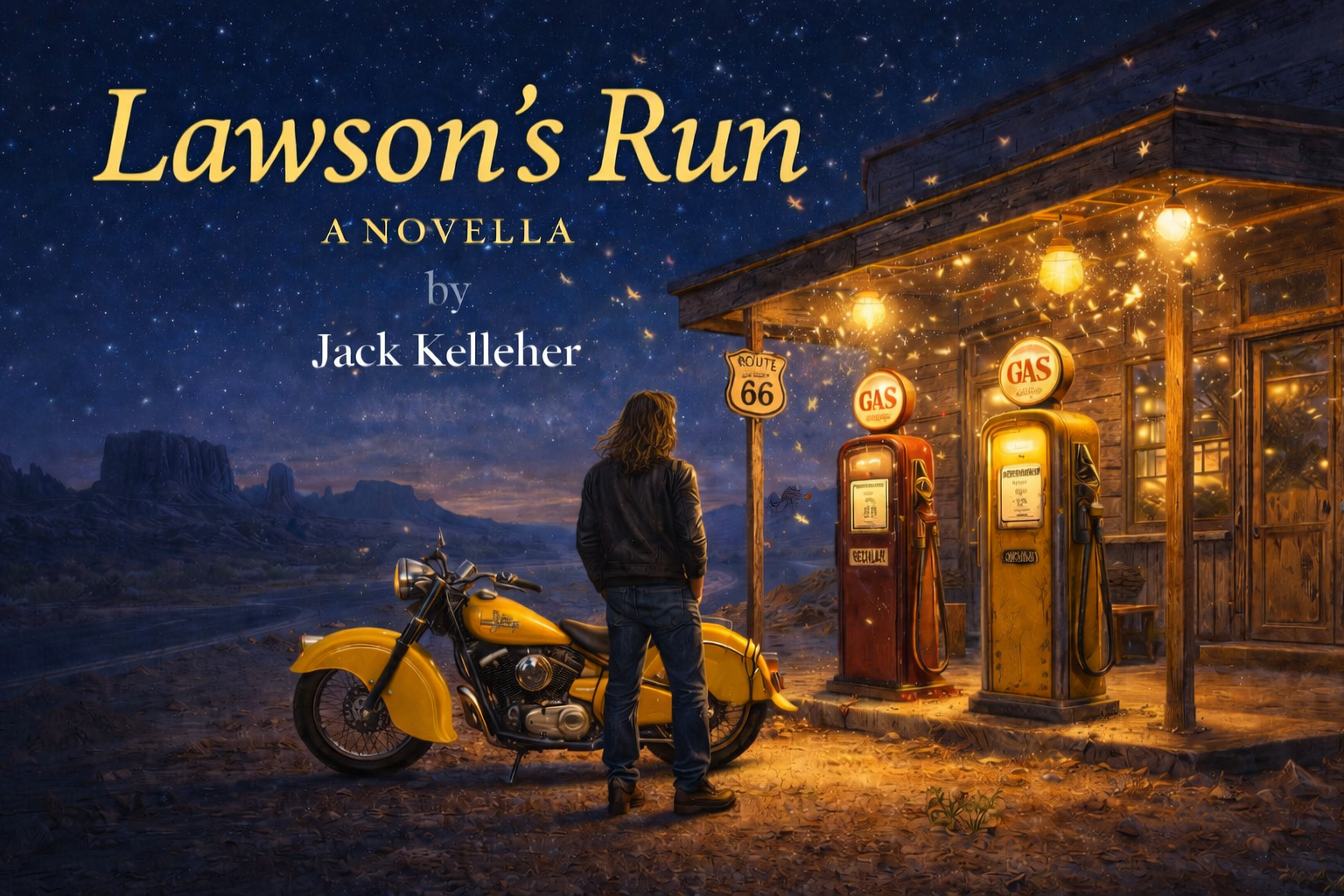
A slender teenager in a chambray shirt, buckskin jacket, and Levis rolled his idling Indian Motorcycle to a stop beside the wagon. Shoulder-length honey-brown hair spilled beneath a bandanna. He looked too young for the emptiness in his eyes. His name was Jim Lawson.
Jim dismounted slowly, peering through the diner’s fogged window as he rocked the heavy motorcycle onto its stand. Inside, a middle-aged waitress rose from a stool and polished the chrome jukebox. She wore a pale pink uniform, hair pinned beneath a starched cap. At the rumble of Jim’s arrival, she glanced up, but her placid face showed no emotion.
Something in the way the waitress tilted her head struck Jim — a gesture from another lifetime.
He knew her.
The diner looked trapped in its bygone era — a colour-washed postcard of Bonnie and Clyde on the run, Bonnie with a Thompson gun on her hip, Clyde’s revolver peeking from inside his coat. Standing beside his old motorbike, Jim felt frozen in the same slice of time. For a moment the waitress and Jim watched one another through the glass, unmoving.
Fat raindrops shattered the stillness, dappling the parking lot like chocolate coins. Jim sprinted for the door.
Springfield, MA, 1952
Jim felt the subsonic throb of Zeke’s motorcycle through his bare feet before he heard it rounding the corner. Water in the birdbath danced in concentric circles as the war-surplus Indian rumbled down the street, shuddering the earth before it. Jim ran up the dirt driveway and opened the garage door wide.
Inside, a workbench occupied the back wall, an array of tools on pegs above it. He liked the shop’s orderliness, its smell of motor oil, solvents, and scorched metal. Jim loved the way every wrench had a place on Zeke’s pegboard. Nothing wandered. Nothing disappeared. Things would be better now that his brother was home from work. Zeke could handle Cora.
The motorcycle idling, Zeke rolled into the garage and snuffed the engine.
‘Hello Jimmy, how was school today?’ Zeke’s big, easy smile was lopsided, like a sinking canoe, and he had a chipped tooth, the familiar imperfections comforting to Jim. They pulled the bike onto its stand together and began wiping it with clean shop rags, both enjoying the ritual.
‘I got two goals and an assist in our game with Wilbraham; one goal was unassisted, a breakaway.’
‘That’s great. Like I told you, Stringbean, if you ever get any meat on your bones, you’ll be deadly on the left wing. What was the score?’
‘Three zip. We blanked them.’
‘Even better. Did you play the whole match?’
‘Had to. A couple of our guys were out sick. It was play both ways or go short.’
‘I bet you’re hungry,’ said Zeke. ‘Did you eat anything after school.’
‘I’m a whole lot hungry, but I stayed outside when I got home.’
Jim looked at his toes and pulled an envelope from his hip pocket. ‘I, uh, got my report card today. I didn’t do so good. I’m passing everything except Government. The thing is, if I don’t improve up to a ‘C’ average I won’t be eligible for sports. They’ll red-shirt me.’
Zeke grinned and hugged him. ‘Little brother, we’ll talk about your grades later.’
Jim blushed, shook his head, and looked down again.
‘Did you tell Cora?’
‘Uh-uh, not yet. I didn’t tell her about nothing. She don’t care.’
Cora was sitting in the breakfast nook, the phone cord wrapped around her forearm, the handset pressed against her ear by her shoulder. A vodka bottle sat on the table, nearly empty. Next to it was a full ashtray. She looked up, annoyed when Jim and Zeke came in.
‘What do you yard birds want?’
Not waiting for an answer, Cora returned to her telephone conversation.
‘I’ll tell you what, darling, that busybody can kiss my grits. What happens under my roof is my business and nobody else’s. If I want to live a little, no old-maid schoolteacher is going to tell me otherwise. If she’s so high and mighty, what was she doing in the package store at 11:00 o’clock in the morning? Besides, my Jim’s old enough to take care of himself.
Okay, I’ll talk to you tomorrow.’
Looking at Jim and Zeke, she said ‘Ronnie wants me to go down to the Cape for a long weekend. Can you two Einsteins fry an egg without me for a couple of days?’
Not waiting for an answer, Cora continued, ‘I’ve got a little headache. I’m going upstairs to lie down for a few minutes. There’s Swanson Dinners in the freezer.’
Cora ran away for good a few weeks later, the day of winter’s first big snowfall. Jim had come in through the back door, leaving his coat, scarf, hat, and boots in the mud room. The house was cold, and he made a fire in the kitchen range, not thinking about anything except getting warm.
He found Cora’s note on the breakfast table next to a full ashtray and an empty tumbler smudged with lipstick. It was written on a page torn from Zeke’s drawing pad, folded once so it would stand up. ‘I can’t do this anymore…. Please don’t try to find me. Love, C.‘
There were two little hearts doodled after her initial. After reading the note, Jim emptied the cigarette butts into the fire, then put the ashtray and the dirty glass in the kitchen sink.
He wasn’t sure if the note was meant for him or Zeke or both of them. If the note had been addressed to him, he’d have wadded it up and fed it to the fire too. He knew what his mom couldn’t do. He realized then that waiting for his mom was a losing game.
Jim ran upstairs and looked for the flag they’d given Cora at his dad’s funeral. It was still in a dusty display frame on the wall above the hall phone. At least she left something. Now it was his.
Jim pushed Cora’s note to one side, intending to start his homework, but other thoughts crowded in. Would he have to live with his grandma in Chicopee? Couldn’t Zeke be his guardian? Jim looked down again at the note, and then focused on his schoolwork. Worrying never fixed anything.
He felt better when he heard Zeke’s old Chevy struggle into the driveway, dry snow squeaking beneath its tires. Then he heard Zeke stamping snow and mud off his boots outside the back door.
Jim handed Zeke Cora’s note as he came in.
After reading it, Zeke said ‘I guess we need to have a talk. Cora’s a mess. I’ll bet you don’t feel so good neither.’
‘I feel fine,’ Jim said, wondering where his words came from. ‘Why’d Mom run out on us?’
‘Sometimes people just can’t deal, Jimmy. It’s not their fault and it don’t mean nothing. She probably doesn’t even know herself why she ran. She just can’t carry her own water. That happens.
‘When Dad shipped out, I promised him I’d be the man of the house; look after you and Cora. I’ve been failing with Cora. She’s complicated, had her dark spells even before Dad was killed. Now she’s gone.’
‘What about me, Zeke? She found her way. She just walked out!’
‘Let’s talk later, after we’ve both had a chance to think.
‘I stopped off at the butcher shop on the way home. I’ll make us beef stew, it’s perfect for this weather.’
‘I ain’t hungry,’ Jim said.
‘I don’t believe that one, Stringbean.’ Zeke rolled his eyes, pulling the funny face which always made Jim laugh, then moved to the counter and began cutting beef into chunks. He cut methodically, his mind elsewhere. Jim went back to his homework. Neither of them spoke.
Later, Jim ate quickly and enthusiastically, his appetite discovered. Afterward, they cleared the table and washed the dishes together.
As they worked, Zeke said, ‘I think we should take down and rebuild the Indian this winter. I’ve designed her a new transmission, one which I can mill out in my spare time at work. We’ll paint her canary yellow with black accents and chrome what we don’t paint.’
‘Can I keep on living here?’
‘I hope so, but we’ll have to be quiet about Cora running off. If Social Welfare gets nosy, we’ll have a problem. I don’t think they’d let me be your guardian. Can you keep your head down about this?’
‘I’ll get a paper route, so I can help pay my own way,’ Jim said.
‘Just get better grades, pal, and don’t get into any trouble. That’s the important thing. If your grades stay sour the school will want a parent conference and then we’ll be in the soup.’
‘I’ll keep my end.’
‘And don’t you worry about Cora neither, kiddo,’ Zeke said. But Jim did.
Standing at the kitchen sink, he wondered how he could feel so empty and so free at the same time. Life would be easier without his mom’s mess and constant ragging, but her leaving felt like a stone in his guts.
Jim looked out into the snow haloing in the yard lamp above the garage door. The snowflakes swirled and sparkled reminding him of dust in the attic window, but the night was bitterly cold. He hoped his mom was somewhere warm, somewhere safe.
Jim the Bedouin:
Western Massachusetts, 1952 – 1960
Jim’s school noticed Cora’s absence. Gone were her frequent, rambling phone calls and unscheduled appearances lodging teacher complaints or to ‘discuss Jimmy’. When their relief turned to suspicion, then concern, they called the Department of Social Services hotline.
A few days later, Norma Swenson, a matronly Children’s Services worker, arrived accompanied by a uniformed cop. She made a little speech and gave Jim fifteen minutes to pack an old cardboard suitcase she’d brought along. It smelled of mothballs and unwashed clothing.
Zeke hugged him at the door and said, ‘I’ll get you back little brother.’ Jim held onto Zeke until Swenson pulled him to her waiting car.
The judge decided Zeke was too young and his grandmother too old. Jim’s protests meant nothing. Over the next year he abandoned sports except for judo, the one constant Zeke paid for — the only place rules made sense. Foster homes came and went, each with its own code, each ending in chaos and anger. He became a “suitcase kid,” forever unpacking, forever leaving. New schools, lost friends, no steady ground beneath him. Jim came to hate the randomness — and began to hunger, though he couldn’t yet name it, for a life ordered by clear lines and hard edges, not a judge’s whim. He felt like a lab rat.
Jim broke from care repeatedly, always running home to Zeke. Norma Swenson, who’d argued that Zeke should be Jim’s custodian, tacitly approved and dragged her feet to give Jim respite with his brother. During these times, while Norma dithered creatively, Jim lived with Zeke, the brothers restoring the Indian motorcycle together.
And Jim loved the orderly world of motorcycle mechanics; cams and rockers, cogs, chains, and gears, hundreds of them, all dancing in perfect synchronization. The big Indian was a thing of steel and leather, elegant in its symmetry. Why couldn’t life be so beautiful?
In one such hiatus, Jim began earning his high school equivalency diploma at Springfield Junior College and, during another, took a freshman level English class. But, eventually, Norma would arrive with a smile, an apology, and a new ‘home address’ for Jim. Everyone knew Jim did better at home with Zeke, but Jim’s status had become a contest of wills with the judge who was determined to stick by his original decision.
Jim was three months short of his 18th birthday when he had a fistfight with his foster father, an advocate of ‘tough love.’ Jim bloodied the man’s nose and Family Court sentenced him to secure placement, welfare-speak for juvenile jail, for the remainder of his minority. When he failed to appear for commitment, a warrant was issued for his arrest.
After court, Swenson found Jim at the Student Union drinking coffee. A large woman, she settled herself in the booth across from him, then spoke.
‘Jim, Judge Henderson is hopping mad. He just issued a warrant for your arrest. You know I don’t want to see you in trouble, but I’ll get fired if I don’t give it to the Sheriff’s Office within ten days. I just think you should know. I’ve been very busy lately and won’t get it over to the Sheriff until I must.’ She shrugged and smiled sadly. ‘I do what I can, Jimmy.’
Norma spoke softly, but Jim heard the ticking of a clock behind every word — another schedule he didn’t control.
Jim, now tall and awkward, stood to lean over and hug Norma.
‘You’re a friend. I’m sorry for the trouble I’ve been.’
‘It’s okay, honey, you’ve never been any trouble. It’s what I do. Without you and other kids to chase after I’d still be a barmaid and I don’t have the figure or feet for that anymore.’
Jim imagined Norma Swensen holding two frosty schooners of beer in each hand, working her way through a crowded bar. It made him smile. Somehow it worked, Norma was like a high-mileage barmaid, bighearted and hard working. He’d miss her.
Jim Takes Wing:
When Zeke got home that night, Jim was sitting in the kitchen drinking a beer from the bottle.
‘What’s up?’ said Zeke.
‘I’ve gotta run this time. The judge sentenced me to juvey until I’m eighteen. I knew he would. If I’d been in court, I’d be locked up now. He issued a warrant.
‘Detention ain’t for me. You practically need a hall pass to take a leak. There’s a guard on duty around the clock. And, I’d be in a box with a lot of snotty little criminals.
‘Worse, the brother of the guy I popped works there. How do you think that’s gonna work out for me?
‘I’ve been a gypsy ever since Mom ran off. People call me ‘Jim the Bedouin’. I might as well hit the road and be one until I age out of this bullshit. Maybe I’ll go out West, look for Mom.’
‘Do you have a plan beyond running away?’
‘As soon as I’m eighteen, I might enlist in the Marines. If I sign up for six, they’ll pay my college tuition when I get out.’
‘Whoa! What? How do you know this? A couple of months ago you were reading Siddhartha and all Buddhaed-up on loving-kindness. Now you want to become a Marine? What is going on with you, Jimmy?’
‘I’ve been talking to a recruiter at the placement office. I’ve got to do something to break out of the life I’m in. If I don’t, I’ll wind up in county jail next, then graduate to state prison. I’m already a courthouse regular, know the deputies by name. Judge Henderson calls me Jimmy. You know how it is. I’m right.
‘The Marines is an orderly place to earn my keep and get a college education. I won’t turn into a killer.’
‘Why not the Coast Guard then, saving lives not taking them? Think about it before you sign up.
‘I’m not so sure looking for Cora is a good idea either. If she wanted to see us, she knows where we live.’
They talked into the night.
In the morning, Zeke handed Jim the keys to the Indian and gave him $100 cash.
Before he reached the interstate, the motorcycle’s engine had settled into a relentless throaty rumble and Jim felt like a gannet on the wing — committed, no turning back.
A Kiss:
Near Gallup, New Mexico
Summer 1960
Route 66 between Albuquerque and Winslow was an endless ribbon of simmering pavement. A gibbous moon lent an eerie glow to the surrounding desert, an ocean of barren soil, standing rocks, and low scrub. Oncoming cars refused to dip their high beams. Only truckers had sympathy for a lone motorcyclist storming through the suffocating wilderness night.
Stopping about two a.m. at Lou’s Kwik-Fill, Jim could still feel the day’s heat through his boot soles. He was thirsty, hot, and dirty. His arms and back were numb from the vibration of the motorcycle and the constant slap of tar-filled seams in the concrete road. His face felt as if it’d been sandpapered. And, he was bone lonely.
But, he’d made it to the desert! When he and Zeke sketched his route on a Texaco road map in Springfield, they had no idea what it would be like. America was vast. Today he’d get to Kingman, find an air-conditioned motel and sleep until sundown. He’d push on to California tomorrow night under the stars.
Jim pumped his own gas while Lou, the sleepy station owner, rambled on about the joy the graveyard shift and the upcoming presidential election. The station and ‘Red Sally’s,’ a now dark beer bar, were the only signs of human habitation as far as could be seen.
Gesturing toward the bar, Jim asked ‘Where’s Sally?’
‘In bed, out back. Sally’s the missus; snores like a diesel locomotive. We work different shifts, it’s the key to a long marriage; keep your distance.’
‘How long you and her owned this place?’
‘It’s Sally’s going on twenty years now. Sally bought it and fixed it up with an Indian claims settlement she got. I was on my way to Las Vegas and just fell off the back of the bus and married her. In case you ain’t noticed, you’re on the rez. This here is tribal property.’
‘You remember a woman named Cora Lawson working here?’
‘Cora? Sure do. She was a looker, hard worker and funny when she was sober; ran off with a traveling preacher named Reverend Stan Waters. Why you ask?’
‘Cora was a family friend when I was a kid, once sent a postcard of Sally’s to us. I’d like to pay her a visit, say hello.’
‘Reverend Stan was a Pentecostal missionary stumpin’ around the reservations with a circus tent, a quart of Jim Beam, and a cockeyed organ player; crazy as a shithouse rat. The Indians put up with him because he gave them a laugh, some free entertainment. They called him Reverend Make-Waters. When he got up a head of steam he was something to behold preaching damnation, fire and brimstone; speaking in tongues, the whole nine yards.
Rev. Stan heard Jesus talking to him in the desert air, hell, when he was drunk he even talked to the Almighty in the privy. He had a home base in Slates Hot Springs out on the Big Sur in California. Baptized Cora and she went just as Jesus nuts as him; back on the booze too. The pair of them ran off together. If I was lookin’ for Cora, that’s where I’d go, Slates Springs.’
Jim recalled a postcard of a Big Sur diner that Cora had sent to his grandma.
‘That’s $1.20 for the gas, anyway, son. I’d go out of business if everybody rode motorbikes, even big ones like yours. At thirty-one cents a gallon, I can’t make no money unless folks fill up a big tank.
‘I love to see a Buick Dynaflow roll in. They got a twenty-gallon tank and suck gas like a San Francisco hooker, but they are mighty comfortable. Hell, I could sleep full-length in the back seat; do other things back there too.’
‘I’ll stick to my scooter,’ Jim said with a wink. He handed Lou a five-dollar bill and wiped down the Indian, checking its tires and oil level while waiting for change. Then, he kicked it back to life, its vibration and rumble enveloping him. Jim smiled, feeling a kind of spiritual unity with the rugged old motorcycle.
As he was doing this, a slender girl walked out of the station kiosk and, closely followed by Lou, came up to Jim’s idling bike. She wore scuffed western boot, tight jeans, and a ragged denim jacket. Her hair was braided down her back. Even with her boots, Jim towered over her. She stopped a few feet from him and looked down, arms at her sides.
Lou still had Jim’s bill in his hand. ‘This here’s my wife’s niece, her name’s Blue Raven, but I call her Molly; like my Sal, she’s Chiricahua Apache. She don’t weigh much, do you think you could give her a lift to Winslow? I’d give you back your gas money.
‘Her step-father’s a Deputy and the kind of mean son-of-a-bitch that gives us white people a bad name. Knocks the kid around, probably tryin’ to get into her pants. She’s waiting for the Greyhound bus, but’s afraid he’ll come for her before it gets here. She wants to put some distance between herself and him by sunup. She’s going to Kingman to stay with another aunt.
‘Just so you know, she’s sixteen, so don’t let her tell you otherwise.’
‘Almost seventeen,’ Molly said without looking up.
‘Apache women are all too goddamned clever and mouthy. Sally’s always two moves ahead of me. Blue Raven don’t talk much yet, but my Sally makes up for her. Never mind that, but just don’t let her talk you into runnin’ off together unless you want to start a injun’ war. She’s got more kinfolk than coyotes got fleas.’
Jim smiled at the girl and offered his hand. ‘Name’s Jim, people call me Gypsy. You can trust me, Molly Blue Raven. Just climb on.’
Molly smiled, tied a bandana around her head, and clambered behind Jim, wrapping her arms around his waist. The girl’s touch made Jim feel shy, but less lonesome. They motored off together into the desert.
Jim’s clearest memory of that night was of jackrabbits standing upright along the roadside, transfixed in his headlight, like Pentecostals in extasy, their eyes glowing red. Sometimes it was just one, others there would be a whole line of them, a dozen or more. He wondered to whom they prayed and for what. ‘Save us, oh Lord, from the Coyote’s bloody jaws; save us from the beam-eyed reapers of the night!’
He’d write to Zeke telling him about the jackrabbits and about the Indian girl on the run; maybe give him a phone call. You’d never see holy jackrabbits in Massachusetts. And, if Blue Raven was any example, Apache girls were pretty. A call would be better, no postmark. The welfare hounds might still track him.
They had breakfast together at Sambo’s in Winslow, Arizona, Blue Raven finally beginning to talk. They lingered over coffee. Looking into her big, dark eyes, Jim was tongue-tied, had butterflies in his stomach.
‘I’m going right on to Kingman,’ Jim told Blue Raven. ‘Would you like to come the whole distance, or do you just want me to drop you off at the Greyhound Bus depot? I’d be glad to take you all the way to your Aunt’s door if you can stand being on the bike that long.’
Blue Raven smiled and nodded her head. ‘My step-dad might come this far and look for me at the Winslow bus station. A ride to Kingman would get me shed of him.’
When they finally parted, Blue Raven surprised Jim by handing him a postcard on which she’d neatly lettered her mailing address in Kingman. ‘Write to me Gypsy Jim. After I graduate high school I’m going to college. Maybe we’ll get to know each other someday, be friends.’
Jim offered her his hand, but the girl surprised him again. She stepped close, stood on her tiptoes, pulled him down, and kissed him full on the lips. Jim could still feel that kiss hours later when he woke in his motel room before returning to the road. Alone again.
California Coast:
Jim reached the end of Route 66 at Santa Monica Pier, California, at 11:00 o’clock at night. Street lamps ran along a concrete boardwalk and out the length of the pier, palm trees casting deep shadows onto the gently glowing sand. Beyond the beach, under a sickle moon, was the Pacific Ocean. The night was quiet except for a campfire gathering about one hundred yards north. Someone had a guitar and they were singing folksongs. He smelled marijuana and jasmine on the night air.
Jim avoided the beach party, stripped naked beneath the pier, and dove into the surf. Although the night was warm, the ocean’s cold was breath-taking, not at all like he’d imagined. Braving this, he swam beyond the breakers and dog-paddled, looking back at the glowing Los Angeles skyline and listening to voices from the pier above him. For the first time since leaving Springfield, he felt clean, brand new. Los Angeles was a great place. There were good jobs advertised in the papers. Santa Monica had a community college walking distance from the beach. Maybe he’d give it a try.
Pieces were falling into place. Jim’s grandma had left postcards from his mom where he could find them. From them, he gleaned that she had drifted from Arizona to the Big Sur in California, apparently drawn there by its Pentecostal congregation. She’d found religion and sobriety or, so she wrote to his grandma. She hadn’t mentioned the Reverend Stan. Jim thought she might be working at The Seagull Café pictured on one of her postcards. Did she want to be found? Was his mom like Hansel & Gretel in the forest, leaving a trail of crumbs along her path?
Later, Jim lay in the shadow of a palm tree listening to the sea and snatches of songs from the beach party die-hards. He might see his mom tomorrow. He’d tell her that he had his high-school diploma and had completed a course at the community college, getting good marks. He wouldn’t tell her too much about foster care. He’d tell her Zeke was doing well at his job; was already a journeyman machinist. Maybe she would visit Springfield and meet Zeke’s new wife. She’d be a grandmother soon. They’d be a family again. He fell asleep already dreaming.
That night, Jim dreamed he wore gypsy leathers and was riding his big Indian through the Milky Way. He woke up feeling wonderful, took a warm outdoor shower, and put on a new cowboy shirt and jeans. Then he cooked breakfast, broke camp, and eased his motorcycle onto the northbound Pacific Coast Highway, heading north toward Malibu, where the movie stars lived.
The Seagull Café:
The sky opened as Jim ran for the entrance, spoiling his newfound biker swagger. He slipped on wet concrete and collided with the phone booth beside the door. Rain hammered the aluminum roof while he fished for quarters.
The ringing sounded thin and metallic.
“Hello?” Zeke’s voice — cautious, hopeful.
“Zeke, it’s Jimmy. I’m in California.” He hesitated. “I’m looking at Mom through a diner window. She doesn’t know I’m here yet. I think I could make a life out here. Work, maybe college.”
A long breath on the other end.
“Jimmy… thank God you called. Norma Swenson was here two days ago. Your foster father — the tough-love fat guy whose nose you bloodied — he died. Brain aneurysm. Just dropped.”
Jim closed his eyes.
“Norma’s worried the cops might say you caused it. Manslaughter if they push it. And you’re already on the run.”
“Oh, Jesus…,” Jim said. “I hated him, but I didn’t want him dead. I was just defending myself.”
“You may have to explain that to somebody,” Zeke said quietly.
Jim swallowed. Rain rattled harder.
“Do you think they’d come for me if I enlisted?”
Silence — then a soft exhale. “That’s a hell of a question, little brother.”
Jim hung up before Zeke could say more. He pushed through the door, peeling off his soaked bandanna and buckskin. With hair plastered to his forehead and shirt clinging to his narrow chest, he looked like a stray pup caught in a storm. Cora stared straight at him; head tilted in the birdlike.
Rain drummed on the roof, swelling to a roar. She stepped back.
“Stan! Stanny, honey — come out here please!”
The kitchen door banged open. A burly man in a grease spattered Another Boy for Jesus T-shirt stormed out gripping a Little League bat. Cora caught his arm.
“Stanny, it’s okay. I just had one of my spells. Go on back.”
He lingered a beat, glaring, then disappeared into the kitchen.
Cora squinted at Jim, head cocked.
“Do I know you? You look like somebody I used to know back east.”
Jim shrugged. “Maybe.”
Cora poured a mug and pushed it across. Coffee sloshed against the rim. Her knuckles were red, nails bitten short. Jim caught a whiff of vodka smell. She stirred the cup lefthanded — three slow turns — and Jim watched the spoon circle like a clock running backward.
“You passing through?” she asked.
“For now.”
He drank. Hot. Bitter. The word Mom pressed against his teeth. He swallowed it.
She waited a second longer, as if searching her memory, then turned to wipe the counter.
Jim set a dollar under the mug.
“Thanks for the coffee… ma’am.”
Outside, the rain had eased to mist. Morning light broke through ragged clouds, turning the wet asphalt silver. Jim shrugged into his buckskin and walked out the door.
When he kicked the starter, the engine’s vibration rattled the diner window. Inside, the vodka in Cora’s mug danced in concentric circles.
Jim didn’t look back.