Content Note: This is a work of dark fiction involving explicit sexuality, violence, and the supernatural. It examines remote warfare, obsession, and the long afterlife of American myths.
Creech AFB
My name is Munroe – TSgt Munroe Wilkes St. Helen, callsign Carney. I fly the MQ-1 Predator, an Unmanned Aerial Vehicle, which the newspapers call a drone. I’m among the last of a class of video game kids corrupted by the US Air Force. I’m a dinosaur and relic of an abandoned program. Still, I excel at my job. In combat, I attain spiritual unity with my UAV. I am Predator.
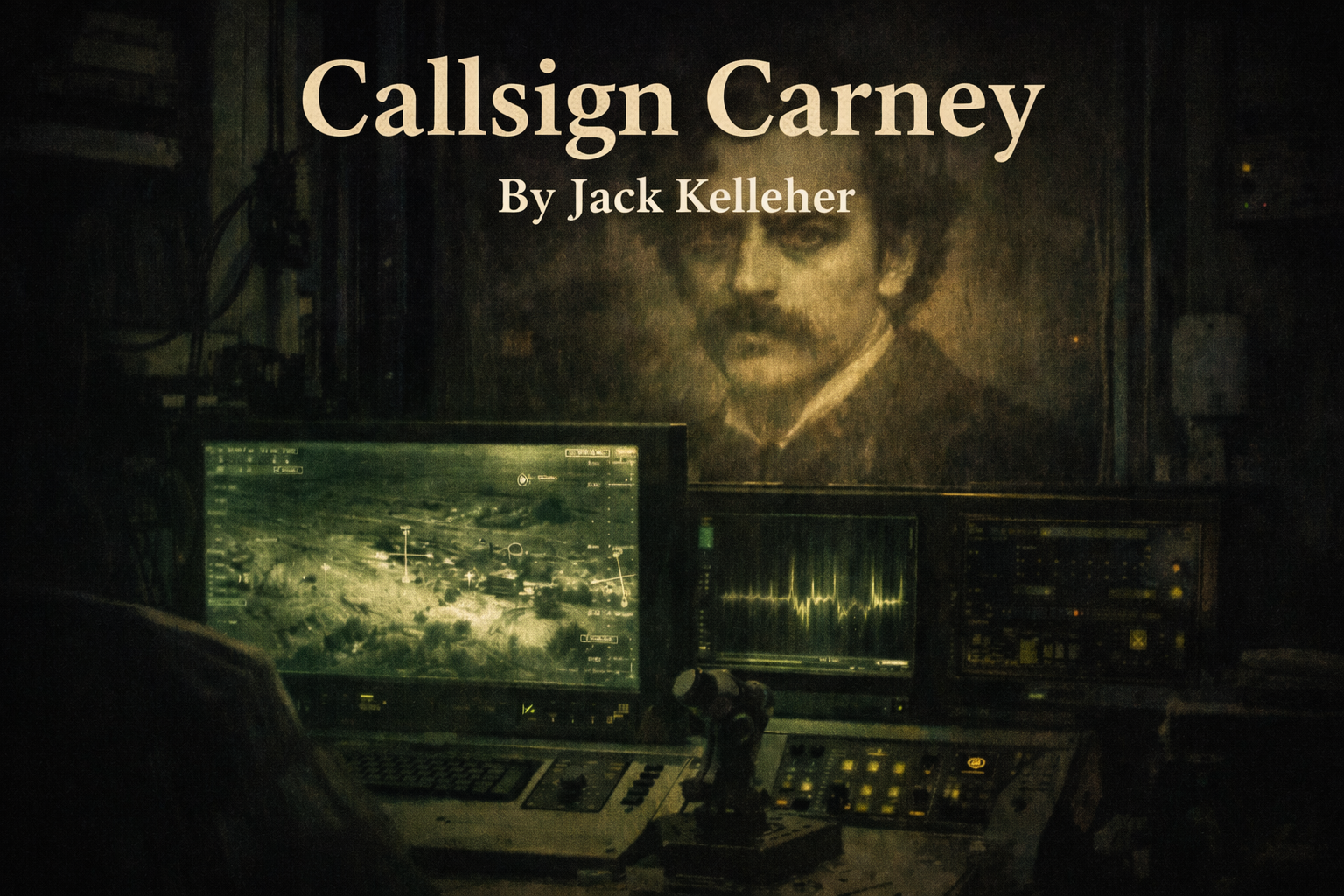
My cockpit is at Creech AFB, near Las Vegas. Atop the flying console is a photograph of my ancestor, Shakespearian actor and presidential assassin John Wilkes Booth. He looks directly into the camera, but his eyes aren’t focused. He has the thousand-klick stare of the mentally-damaged combat veteran. He’s standing outside a rough, wood-plank cabin. There isn’t a patch of grass, just parched earth and granite rocks the size of grapefruit. A couple of sheep and a tumbleweed complete the time-worn sepia tableau. According to a handwritten note on the back, the photo was taken in 1875, a full decade after Wilkes was reported dead following a gunfight at Garrett’s Farm, Virginia. He doesn’t look particularly happy that he survived, that his demise was fabricated by Pinkertons who claimed the bounty on him after smoking a lookalike. I figure he was vexed at having to live out his exile on the lam in a hardscrabble shithole, shagging sheep instead of society matrons. But things got worse for poor old Wilkes. A whole lot worse.
Aunt Addie
My grandmother was a famous tattoo artist, an ink-slinger at the Long Beach Pike, a gamy sailors’ amusement park in its day. Her name was Adelaide St. Helen, but everybody called her ‘Aunt Addie.’ Aunt Addie was a tattooing legend, an artist and innovator. Tattoo people still purchase the Taschen art book exhibiting her unique flash.
After my mom hoofed it, I bunked with Aunt Addie and practically lived on her memories of carney life at the Pike. She had a special place in her heart for a ghost train called The River Ride, a jerky rail procession into a darkened tunnel filled with recorded screams and macabre tableaux. The River Ride’s culminating horror was a mummy reaching out of its coffin to touch you, its outstretched arm trailing cobweb.
As it turns out, that corpse was John Wilkes Booth’s desiccated body. The great Shakespearean had a show business revival following his suicide in Enid, Oklahoma. After barnstorming America in a coffin in the back of a truck, Wilkes took his final curtain at The Pike, frightening sailors’ girlfriends. Sic semper fortuna. Even as a kid I appreciated the irony of his swan-song. The River Ride stank of urine and beer vomit. Abe Lincoln, the hick demagog, had the last laugh.
Still, there’s something unjust about Wilkes’s end. Unlike later presidential assassins, he wasn’t a loony with a gun. With some justification, he saw himself as the secret agent of a foreign power, the Confederate States of America, a combatant, performing a mission for his beleaguered nation. His operation, which he completed admirably, was to decapitate his enemy’s government. It was just bad luck that Wilkes’s country shortly ceased to exist, making him a traitor, not a hero.
A Galaxy of Black Widow Spiders
When I moved in with Aunt Addie, she told me I could play anywhere I wanted except the canning cellar. She said there were black widow spiders underneath the house and that the female’s bite could kill you. So, being a ten-year-old boy, I had to get into that basement. My sidekick Larry Stubbs and I dared each other to sneak into the cellar and catch a black widow in a Mason jar.
We planned our spider safari to take place when Aunt Addie would be busy upstairs with her ink trade. Aunt Addie still tattooed when the money was right.
When the day arrived, we were stealthy. I oiled the rusty steel hinges on the outside cellar door. It was made of green wooden slats and had a hasp, but no lock, just a bolt through the galvanized metal loop. I oiled that too.
When we pulled back the door, a shaft of dusty sunlight filtered into the depths beneath the house. The air smelled like snakes, hot and rancid. We spotted our prey, hundreds of shiny black spiders, none moved by our intrusion. In watchful stillness, they looked like obsidian stars in a gossamer Milky Way.
We cleared some web with a broom and eased down the stairs, pausing at the bottom. There were rough shelves of home-canned fruits against the walls and, in the middle, an unpainted wood-plank coffin sitting on a pair of low sawhorses. It was shrouded in cobweb.
Larry said, ‘You go in. I double-dog dare you.’ His voice quavered. He was spooked. I knew he was about to bolt up the stairs, probably screaming and wind-milling his arms, getting us both into trouble. Larry was chickenshit, plain and simple. He was always getting us in dutch.
‘Just be cool.’ I pretended bravery. In fact, I was too dumb to be worried about the spiders. I’d seen coffins in cowboy movies, but yet had no horror in my hayloft, just a vivid imagination. ‘I’ll look in the coffin first,’ I said. ‘Maybe there’s a sleeping vampire and we can drive a stake through its heart. We’ll be famous. Maybe there’s outlaws’ treasure.’
I was thinking about Janie Stubbs, Larry’s older sister, hearing of my bravery. Although still flat-chested, Janie was more interesting than Larry. I wasn’t yet sure why. Things in that department became clearer soon enough.
When I pushed back the coffin lid, I found the dry and shrivelled corpse of a delicate, slightly built man with slicked back steel grey hair and protuberant jet-black eyes. They looked like marbles. He wore a decaying white shirt with jade cuff-links and black trousers. The fabric of his clothing was powdery with age. The exposed parts of his body looked like skeleton shrink-wrapped in ochre plastic. His teeth were bared in an impotent snarl. I felt sorry for him. Knowing Larry was paralyzed with fear, I stepped back and said, ‘Larry, come on over and take a look. There’s absolutely nothing to be afraid of.’
That was the exact moment when the black widow on my neck elected to bite me, ending our spider safari and beginning the worst twenty-four hours of my life.
As I ran screaming and waving my arms, Wilkes began our conversation. I heard him say, ‘You just took a smart pill, youngster, but you’ll endure. Thankee for not driving a stake through what’s left of me.’
Aunt Addie was right about a black widow’s bite. I nearly died. Wilkes was right too, I endured.
When I got home from the hospital, Aunt Addie sat at my bedside. She said, ‘Munroe, you disobeyed me and were nearly killed, but you met somebody very important in our family. That body down below is my Granddaddy, John Wilkes Booth. He was callin’ himself John St. Helen when he met my Grandma Carina. That’s why your last name is St. Helen.’
‘Why’d he change his name?’
‘There were lawmen, bounty hunters, and other riff-raffs looking for him. He changed his name to give them the slip.
‘I only saw Wilkes once or twice. Grandma Carina died before I was born. He just drifted in like a cloud shadow on the land. He was drinkin’ hard and down on his luck. We saw him and then we didn’t see him no more. Daddy read in the papers about him dyin’ back East in Enid. Some people had already sussed that he was Booth, not St. Helen. He heard ’em comin’ and kilt hisself. I think he was plain tired of runnin’.
‘Years ago, when I was new at the Pike, the River Ride added a corpse to its collection. They said it was the body of John St. Helen, maybe Booth, but as far as I know, nobody clocked that he was my Granddaddy. People already called me Aunt Addie. I recognized Wilkes; figured he’d come home for good.
‘When the Pike closed, I boosted his body. I’ve been saving up for a memorial, so I can bury him proper. I’m goin’ to do that real soon now just in case anybody gets wind of what you and that doofus Stubbs kid saw.’
True to her word, Aunt Addie had Wilkes buried in Long Beach Municipal Cemetery. Although she knew him to be John Wilkes Booth, she marked his grave with a modest tombstone reading:
John W. B. St. Helen
1838 – 1903
Actor
Wilkes, that’s what he likes to be called, has haunted me ever since we met in Aunt Addie’s root cellar.
Ink In My Blood
As a kid, I was delicate, artistic and shy, a magnet for bullies. And lonely. I hated school and feared being there. The bullies called me Carney, a nickname which really stuck. Wilkes understood. When I was alone, he kept me company and encouraged me to draw. Looking back, I see my childhood as a continuous colorful scroll of cool cars, dragons, bats, battlefields, angels, and horned demons.
Aunt Addie noticed my talent and apprenticed me to the trade. By the time I was sixteen, I was a journeyman ink slinger, but still had trouble making it with other kids, particularly girls. Only my skill as a tattoo artist saved me socially.
I hung out with Goths, kids who had piercings, dressed in black, and wore eye makeup. We socialized in video caves at the mall, always in darkness and awash in noise. We interacted by playing electronic games. Occasionally, I’d tattoo someone in a spot where it wouldn’t be seen by their parents. This was strictly outlaw ink and I could have gotten in a lot of trouble, but it helped me have a few friends. As it turns out, that’s how I got together with Janie Stubbs, my first girlfriend. Janie was Goth and older. I tattooed paisley tramp stamps on her backside. Janie broke my heart anyway. She got knocked-up by the Produce Manager at Piggley-Wiggley. Wilkes said, ‘I told ye so,’ but chuckled.
Wilks & Me
Aunt Addie passed on just as I graduated high school. The good old woman finished her life as she completed the thankless task of rearing a weird kid in a roughneck oil town. I was with her the morning she departed. Wilkes took her hand and helped her leave her body. She told me she might be back from time-to-time, but I haven’t seen her since. I think she was just tired of child rearing and left me to Wilkes, so she could take a rest. He comforted me and recommended I enlist in the Air Force, so I’d have a meal ticket and bunkhouse while I finished growing up.
We’ve become very close, Wilkes and me, since then. Sometimes we argue about American history, but never about whether he’s my ancestor. The old photograph of him outside the cabin was in Aunt Addie’s things when she died. It confirms our relationship. In black trousers, old fashioned shirt, and his jade cuff-links, I’m a ringer for John Wilkes Booth. I even sport a moustache like his. As he says, ain’t that a daisy?
Combat & Confidences
Flying combat aircraft is exacting work. However, a lot of it is just boredom. Wilkes keeps me company. When we talk, nobody else hears us. When I’m on a mission, he’s there, sometimes reciting Shakespeare from memory, others making his oddball puns.
It took a while for us to communicate. At first, Wilkes said things like ‘I’m as warm a patriot as any man’ and called Abe Lincoln ‘a syphilitic cur, vile and barbarous as a Boston abolitionist.’ I had trouble wading through his flowery language, although I confess I recycle it. For instance, when Lt. Nolan, a geek, soiled herself during a mission, I told another enlisted pilot that it was ‘an incident which excited risibility, maugre my fatigue.’ He didn’t fully understand me but laughed at my recitation. So did Wilkes, he added ‘To pee or not to pee – that is the question.’
Sometimes Wilkes and I talk about life within a command structure. He wishes he hadn’t been ordered to assassinate Lincoln. He says the Confederate States would have done better if Lincoln, not his Vice-President, Andrew Johnson, had been in charge after the Civil War. Johnson was supposed to have been killed too. Leaving him alive trashed the mission. I know how frustrating that outcome can be. When you’re killing, it’s better to err on the side of inclusion. As the Marines say, let God sort them out.
It’s a fact, though, that what Wilkes loves best is theatre, not killing people. We’re apart on that. He’s a big fan of Rod Serling and he adores Di Caprio’s Romeo & Juliette; says Claire Danes is a goddess. She reminds him of a woman he loved before he met my great-great grandmother whom he calls his ‘lost Carina’. Wilkes is an educated, cultured, and sentimental man.
Sharell
Then there’s my new wife, Sharell. We met when I started flying at Creech. I’m not a gambler, it’s for rubes, but Vegas called me. The strip is a modern-day Pike, sex, booze, thrill rides, and garish lights; everybody fucked up. Vegas makes Sodom and Gomorrah look like Girl Scout camp. If I were describing Vegas as a school of art, I’d call it Goth-Deco. I loved it.
One night, Wilkes and I went to The Sands Hotel to play blackjack for a little extra cash. With his help, I don’t lose. Sharell worked in a sleeveless white blouse and short shorts, scarlet pumps, garters, and black lace stockings. She wore starched shirt cuffs on her wrists with spider cuff-links. I was lightning struck – totally undone by her. Wilkes says she ‘glamoured’ me.
As she dealt cards, Sharell said she recognized the black widow on my forearm as the latter-day ink of Aunt Addie. I told her that the art was my own; that I was Aunt Addie’s last apprentice. That began our two-hour courtship.
Sharell is an ink bunny; she knows her tats. As soon as she heard that I was Aunt Addie’s grandson, she begged me to tattoo her breasts with symmetrical black widows in Aunt Addie’s vernacular. Of course, I did it. Sharell has beautiful café au lait skin and full breasts, like a teenaged Sophia Loren. She wanted the matching spiders on the piedmonts of those marvellous tits, just below the plimsoll line of a modestly arranged cleavage. Jesus, I loved that ink job!
Alright, so we had great sex for the next week and were married at the OK Corral Wedding Chapel the following Tuesday, our shared day off work. Wilkes was there but, at my request, gave us privacy after the ceremony. At least he says he did.
Since my marriage to Sharell, Wilkes has shown lots of interest in talking about sexual intercourse. You’d think he got enough in life, he certainly says he did. He can get on my nerves. How can a man dead 100 years still want to talk about getting laid? That’s a PhD thesis if I ever heard one.
Sharell has nothing to do with anybody’s PhD. She spends her days weaving rastas in her hair and listening to improv, funerary jazz. She sits entranced for hours. Her stillness creeps me. She looks poised to strike. I’m afraid to disturb her. When we talk, she says what I do is amoral, but smiles. Sometimes she says I’m not a real pilot. Drone strikes are cowardly because I’ve got nothing at risk except my job. Real killing is done mano a mano with your own skin in the game.
Sharell is just trying to provoke me. She’s into rough foreplay, bondage, and sexual asphyxia. I’m a white-bread kind of guy, but her eager pupil. She had to teach me her kinky games. That’s what a good husband does, isn’t it? Sharell cries, curses, and slaps me. I grab her arms and she collapses onto the bed, struggles a little, and then submits. The rest is fade to grey – mind your own business. You too, Wilkes!
A Near Miss
A few weeks ago, I flew a mission which made the Six O’clock News. It was very successful, taking out a major terrorist cell and snuffing fifteen Al-Qaeda cockroaches. After it was over, graphic images of the strike replayed in my mind, taking me somewhere high and fine. Wilkes and I came home drunk on combat killing. We planned to surprise Sharell with a night on the town. We surprised her alright, but Sharell had plans of her own.
As we walked through the front door, she yelled from the bedroom ‘Is that you, Munroe, you wuss? You killed Ayatollah Bishar al-Shirazi. You are the fucking drone!’ Spoiling for a fight, she called me Munroe, not Carney, to chafe and demean me. She kept it up, hardly pausing to breathe. ‘Punk! You murdered the Abraham Lincoln of Islam.’
I tried to appease her, but this only inflamed Sharell. I knew that she was staging an argument, maybe she was leaving me. Jealousy spiked me with adrenaline. My post-mission high was becoming a power-dive into the desert floor. She wouldn’t stop yelling, getting in my face, and circling our bedroom like a prize fighter. However, this soon evolved into something altogether different.
Sharell began taking off her clothing slowly, provocatively, letting garments drift around the room like a web. Her taunts softened into throaty purrs.
As Sharell performed her tarantella, I noticed ink I’d never seen before — more jealousy, more adrenaline. A scarlet hourglass glowed on her midriff. Then I realized it wasn’t a tattoo.
Sharell was changing. She’d been distracting me from her arachnid metamorphosis, corrupting my will with jealous arousal. A searing hunger pooled in my belly. She was my woman.
She swayed, rastas swinging, her skin darkening to a glossy black. The widows I’d tattooed on her breasts, now ghost-white, twitched alive, watchful. Her hourglass pulsed, calling me. I couldn’t look away.
Her human image dimmed like a failing projection. I could see her behind the gauze. I needed to possess her — to consume her — all of her. I gasped like a gaffed shark for the touch of her skin, the clutch of her legs, the salt perfume of her sex.
I had never been so terrified or so aroused. I entered her dance, advancing and retreating, mirroring her movements. We tangoed, swaying, almost touching. Gently, using my full strength, I overpowered her and bound her wrists and ankles, echoing her eerie, erotic resonances.
She struggled, then submitted — moaning, hissing, snarling. Provocations purred from deep in her throat. I answered instinctively, wrapping fishnet stockings around her neck. My voice came from somewhere beyond my control.
She lunged, biting my neck, drawing blood, baring gory teeth. Intoxicated, I barely noticed. I didn’t care.
Wilkes never commented when Sharell and I made love. This time he spoke urgently, tugging at me.
“She’s ensorcelled thee. Whatever thou dost, young’un, do not couple with it. Protect thyself — right smartly. That creature is a black widow and will kill thee directly.”
I shook him away. His warning drowned in mission heat boiling my veins. I wanted Sharell, Wilks wanted her too. I had to have her. And so it was.
There is a moment of weightlessness in flying and in lovemaking. At that instant our eyes met. Sharell sagged, drifting back from her gasping ecstasy. Then she struck for my carotid.
I twisted the already-taut fishnets around her throat. The struggle was brief. I was very, very lucky.
As she convulsed, I slid to the floor, exhausted. Her bite had nearly torn my artery. I was bleeding heavily.
Sharell was dead.
After Wilkes and I cauterized and stitched my throat, we entombed Sharell beneath the house.
The desert twilight had cooled. The air lay still. The pit looked a lot like Aunt Addie’s canning cellar — bare earth, timber, shadow — peaceful and eternal.
We worked without speaking. Wilkes held the light while I shovelled. I did not look at her face. I didn’t need to.
When we were finished, the ground was smooth and ordinary again. Nothing marked the place.
At night, Sharell whispers up through the floor. She purrs that I’m a killer and an assassin — pillow talk. I don’t answer. I’m not going underneath the house, no matter what she says.
Against all odds, I’ve survived two black widow bites.
The glitch is this: the venom hasn’t left me. It surges. I feel a tidal craving to embrace Sharell again.
And the moon is waxing.
I am Predator.