
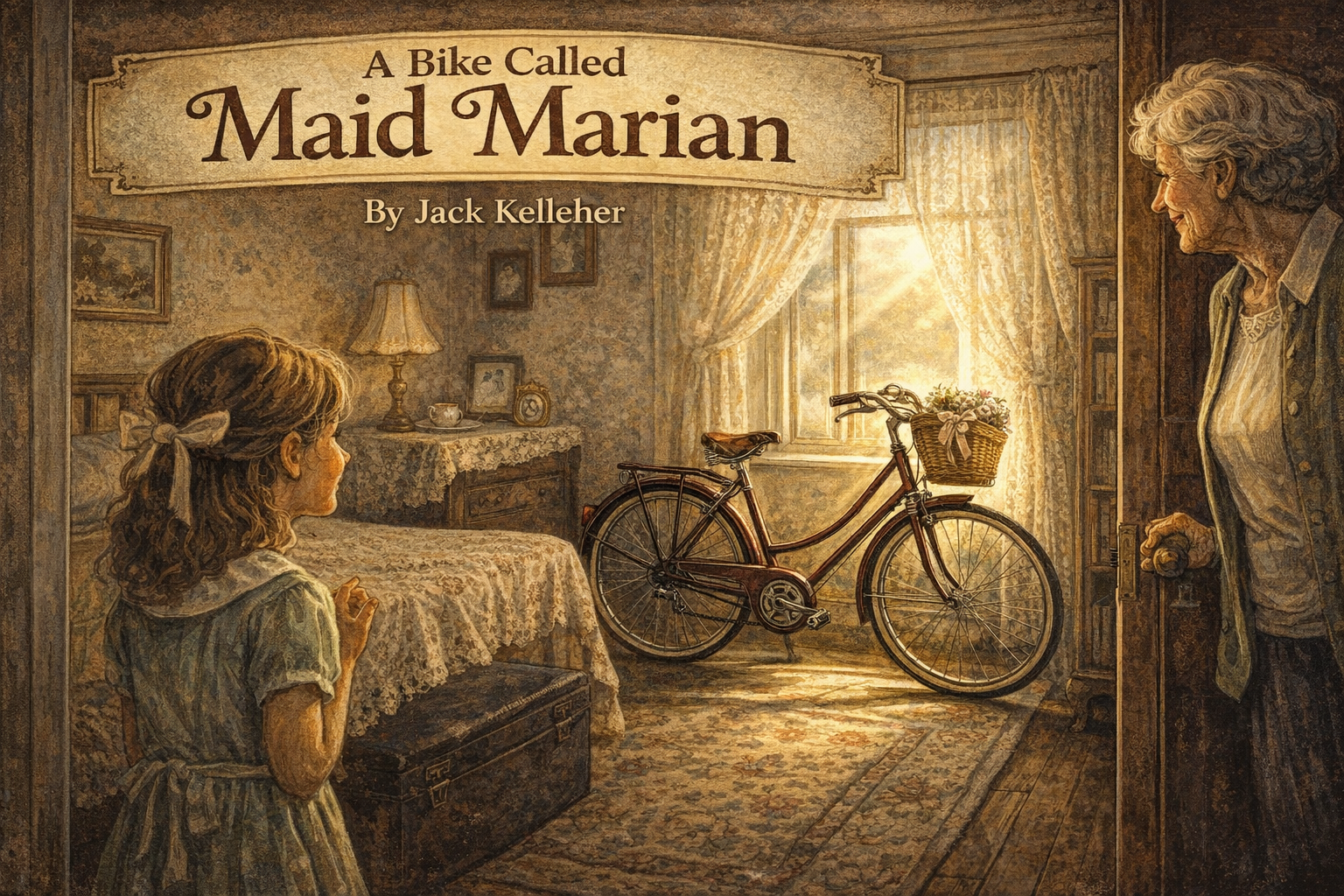
Bitsi wanted a bicycle. Not just any bike, she wanted a Raleigh three-speed lady’s bike with narrow tires and a wicker basket she could decorate with flowers and ribbons. She’d seen one in a magazine advertisement and it was love at first sight. Bitsi didn’t like the knobby-wheeled heavy old things the boys all bashed around on with their bright colors, springs, levers, and doodads. She wanted an elegant velocipede (she loved the word!), one she could care for, make nice, and call her very own. She sometimes mentioned her dream when the family was eating dinner.
‘If I had a bike with baskets, I could help with the shopping,’ Bitsi said.
‘We don’t do much shopping, little one,’ Mama replied.
‘In the summer I could go with the other girls to Inchydoney Beach. I could carry all my things in the basket. I’ll bet I could make money doing people’s grocery shopping for them with my bike too.’ Bitsi said.
‘It’s not proper for a young girl to go about on a bicycle,’ said her Grandmother Umarov. Nana Umarov, Papa’s mother, lived with Bitsi and her parents and big brother, Dokka. Bitsi’s mom nodded as if she agreed with Nana Umarov, but Bitsi had seen photos of her mother cycling back in Grozny. Mama had once owned a bike a lot like the one she wanted. Mama and Nana Umarov didn’t always agree, but Mama tried not to show it. Mama wanted peace in her family. Nana Umarov, not so much.
Bitsi knew Mama worried about money. They didn’t have any. None of the families in The Lodge did. They were refugees, asylum seekers, and lucky to be in Ireland. Lucky to be alive! But they weren’t permitted to work. At least the grown-ups weren’t.
Bitsi’s dad had been a journalist in Grozny and a famous Chechen poet. Now he was just a poet. Dad said, ‘The poetry business is not so good. I should have learned to make pizzas.’ That was his joke, but it was true. Her dad had that kind of humor, saw the funny things in tragedy around him. He said, ‘You know why we had to run away from Chechnya? The Russians can’t take a joke. Those Ivans are very serious people; got right down to business in Grozny.’
Bitsi said, ‘Papa I just learned an American word in a book. They sometimes say ‘skedaddle’ to mean ‘run away.’ We skedaddled from Chechnya.’
Papa smiled and said he liked ‘skedaddled.’ ‘Maybe you’ll be a poet some day too, Bitsi. You love words. My advice is to learn how to make pizza too. A poet needs something to fall back on.’
Mamma gave Papa that look. It meant ‘don’t talk about politics at dinner.’ Bitsi decided maybe tonight wasn’t the best time to talk about bicycles either. She just wanted some ideas about how she might earn enough money to buy her own bike.
After dinner, Bitsi made ten neatly lettered bulletin board notices they read:
MOTHER’S HELPER
Responsible, strong, hard-working girl, age 10, can:
Mind your children after school while you shop;
Run errands;
Walk dogs; or
Tidy your house.
Fair Rates
Bitsi
021-162-2322
Her Mama and Nana didn’t like that idea at all. Nana shook her head and looked unhappy. Bitsi said, ‘ Please, Mama, I’ll let you speak to anybody who calls and I won’t go unless you agree. I can make two Euros an hour and I’ll give you half for your shopping budget.’ Mama said she said she’d think about it. Nana said it wasn’t proper and fingered her prayer beads.
‘Think about it’ means ‘no.’ Bitsi knew that, but she might get her Mama’s approval if she had a live customer on the telephone. So, the next day after school, she put her notices up in all the grocery stores, O’Donovan’s Hotel, and two charity shops.
She did her homework by the telephone in the lobby for the next four days after school. Nobody called.
While she was waiting, she hand lettered a calling card it read:
Bitsi Karina Umarov
Poet
&
Bicycle Messenger
021-162-2322
She thought she’d show it to her Papa at dinner. It might make him laugh that she wanted to be a poet with a bicycle to fall back on. It might get him on her side too.
Friday came and still no one had called. Just when Bitsi was about to finish her homework and get ready for dinner, the telephone rang. She answered in her best English, ‘Hello, this is Bitsi Umarov speaking. How may I help you?’
A very old voice said, ‘Hello, are you the young lady who advertised for employment on Scally’s bulletin board?’ Before Bitsi could answer, the voice continued, ‘My name is Mrs Buckley and I could use a little help on Saturdays. Are you available to come to my house tomorrow morning at 9:00 o’clock to discuss your employment?’
‘I am,’ said Bitsi, ‘but may I bring my mother with me just this once? She would like to meet anyone I might work for.’
‘I think that’s very appropriate,’ said Mrs Buckley. ‘I should like to meet your mother too.’
Getting Mama’s approval was not going to be easy, but Bitsi thought about it. She asked her Mama while Nana was taking her nap. Mama was relaxing, having her afternoon tea. She couldn’t raise her voice without disturbing Nana. They had to whisper when Nana Umarov was resting. Also, without Nana, Bitsi knew she had a better chance of Mama saying yes. And she did.
The following morning at exactly 9:00 o’clock, Bitsi and her mother were at Mrs Buckley’s front door. When she pushed the doorbell, Bitsi heard a chime and, before it stopped ringing, the door opened and she was face to face with a very small old lady. Mrs Buckley was almost the same height as Bitsi, had her grey hair in a pixie cut, and had blue eyes with gold flecks in them. Bitsi thought she looked like an old elf, ‘older than God’s grandmother,’ in a blasphemy she’d learned from Dokka. She immediately felt sorry she’d thought that. It was unkind, and Dokka was a vulgarian. ‘Vulgarian’ was another new English word she’d learned. It fit Dokka perfectly.
They introduced themselves and Mrs Buckley said to call her Mrs B. ‘I’ve got the kettle on the boil, I’ll make us tea and we can get to know each other. Please come in and sit down,’ said Mrs B.
While they waited, Bitsi looked around. She loved Mrs B’s home. It was filled with books; she had paintings and artifacts everywhere, things from all around the world. There were old black and white photographs, some of them with Mrs B as a young woman with a bicycle. Others looked like they might be family from a long time ago.
Mrs B brought in a plate of shortbread biscuits which Bitsi loved. She said they were made in Bandon. When Bitsi reached for her third biscuit, Mama gave her the look and she changed her mind.
‘You’re not very big,’ said Mrs B, ‘Are you sure you’re strong enough to carry groceries for me? I might also need help bringing in the briquettes which Eamonn leaves on my porch. Can you carry them?’
Bitsi started to say that she carried groceries for her Mama all the time, but that wasn’t quite true and Mama gave her the look again. So, she said ‘I’m small, but I’m strong. I help my Mama carry things and work around the house. I can bring in briquettes a few at a time. I’ll hoover up any mess.’ This seemed to please Mrs B.
She started work that very day, going to the market with Mrs B and carrying back her groceries. Bitsi noticed that Mrs B walked with a limp and used a cane, but she moved quickly, better than Nana Umarov. When they got back to Mrs B’s, she helped put the shopping away, brought in a bundle of briquettes, and hoovered.
At noon, Mrs B stopped her and said that was enough for one day. She gave Bitsi five Euros, more than Bitsi had asked for, saying, ‘You’re a hard worker, Bitsi. I will pay you five Euros on Saturdays when you work from 10:00 until noon. Some Saturdays you may have to do my shopping for me. That vain young woman I call my doctor says she doesn’t want me going out in the rain. I have an umbrella you may use. Will that be all right dear?’
‘I can do that,’ said Bitsi, and walked back to The Lodge with a smile on her face. She liked Mrs B.
As the Saturdays rolled by, Bitsi found herself staying after she finished working just to talk with Mrs B who she now called ‘Nora’ at Nora’s request. Sometimes they laughed and gossiped like girlfriends, others Nora shared the things she knew. She was a retired lecturer in English from U.C. Cork and was actually familiar with Bitsi’s Papa’s poetry, but only in translation. Bitsi taught Nora some words in Chechen.
They usually had tea and Nora always made sure that Bitsi had at least three biscuits, the wonderful shortbread from Bandon. Bitsi hated to leave, but had chores to do at home, so she usually left Nora’s around 1:00 o’clock.
One Saturday, just as Bitsi was thinking she’d better go home, Nora said, ‘Bitsi, dear, I know so much about you now, but you’ve never told me why you’re working, spending your Saturday mornings with an old lady when you could be playing with friends.’
Bitsi paused. She wanted to tell Nora that she was pretty new in town and didn’t have a best friend, but that would sound like she was feeling sorry for herself. And, she did have friends. So, she told the truth, ‘Nora you’re my friend and, if you’d let me I’d come to visit even without the work. I like your house and your books and I like you.
Then, Bitsi told her about her dream bike. She said she knew if she wanted a bike, any bike, she’d have to earn the money to purchase it, but she had a special bike in mind. Then she described the lady’s Raleigh she’d seen in the magazine advertisement, it’s shapely frame, wicker basket, and beautiful deep maroon color. As she went on, she noticed that Nora was dabbing her eyes with a handkerchief and stopped. ‘Nora, what’s the matter,’ Bitsi asked. ‘Are you okay?’
‘I know which bicycle you’re talking about, dear. I saw it too in the Sunday magazine section of the newspaper,’ Nora said. ‘I think I’m about to make us both very happy.
I’ve been a lifelong cyclist, actually started when I was about your age. Then I did something foolish in 1978, motorcycling, and broke my hip. Never ride a motorcycle no matter how cute the boy is! My hip didn’t ever fully heal right. I had to stop bicycling and that’s why I use a cane.’
Bitsi hadn’t talked about cycling with Nora before because she didn’t want to remind her that she was old. Now she found out that her friend and she had another thing in common.
But Nora continued, ‘The thing is I had purchase my own dream bicycle just before my accident. I had to special order it because I’m so small. When it arrived I told myself I would get back to cycling, but I never did.’ Nora took Bitsi by the hand and said, ‘Let me introduce you to her. With one exception she’s been in my downstairs bedroom since she arrived.’
When Nora opened the door, Bitsi saw her dream bike come true, right down to the leather saddle and wicker basket. Right down to the gracefully curved top-bar which went from the headset to the seat tube in a beautiful slide, just like a swan’s neck.
Bitsi was speechless.
Nora said, ‘She’s only been out of this room once, when I loaned her for that photo shoot. The photographer’s model is a former student and had seen my bike. I call her Maid Marian because she comes from Nottingham, near Sherwood Forest. What will you call her?’
‘You mean …’ said Bitsi.
‘Yes dear, I mean she’s yours if you’ll ride her and take good care of her. A bicycle is meant to be ridden, not kept in an old woman’s spare bedroom.’
‘I’ll call her Maid Marian too,’ said Bitsi.
On Sunday afternoon, Bitsi skedaddled to Inchydoney Strand on Maid Marian. On her way home, she stopped and told Nora about their first adventure. She had tea and shortbread biscuits with her new best friend.